
CUETMOCK
  • Pricing
  • Mentors
Log inStart freeStart free mocks→

First test, then trust

Try a free CUET mock test.

Join 5,00,000+ students who rehearsed exam day on the exact NTA screen before sitting CUET. On the web and on Android.

Start free mocks →Get the Android app
CUETMOCK

India's #1 CUET Mock Test Platform. Original NCERT-based questions on the exact NTA exam screen — trusted by 5,00,000+ students since CUET 2022.

Get it onGoogle PlayScan to download the CUETMOCK app

Mock tests

  • CUET mock test series
  • Browse all papers
  • Commerce mocks
  • Humanities (Arts) mocks
  • Science mocks
  • Languages & GAT mocks
  • Free practice questions
  • Pricing

Resources

  • CUET exam guide
  • CUET syllabus
  • Universities accepting CUET
  • Expert blogs
  • News & notifications
  • Webinars & counselling
  • CUET score calculator
  • How we estimate your rank
  • FAQs

Company

  • About us
  • Our leadership & team
  • Our toppers
  • Mentors
  • For schools
  • Contact us
  • Terms
  • Privacy
  • Refund policy

Talk to us

+91 7696 6630 56info@cuetmock.comWhatsApp us

Our other platforms

  • JEE Mock — For IIT-JEE aspirants
  • NEET Mock — For NEET aspirants

Newsletter

Exam updates, study material and offers — no spam.

© 2026 NYC Ventures Pvt. Ltd.

701-702, Royal Business Park, Zirakpur, Punjab - 140603

  • Terms of use
  • Privacy policy
  • Refund policy
  • Contact us

iCUETMOCK is an independent preparation platform, not affiliated with the National Testing Agency (NTA). Always check exam details on the official NTA website.

  • Home
  • Mock tests
  • CUET guide
  • Pricing
  • Log in
Home/Practice questions/Chemistry
ChemistryOrganic: Alcohols, Phenols and Ethers

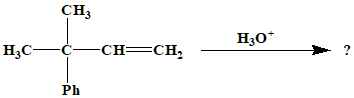
Product formed is:

Figure for Q18

Product formed is:

Answer & explanation+

Correct answer: option 3

The correct answer is Option (3) → CH3–C(OH)(Ph)–CH(CH3)–CH3

Acid-catalysed hydration of an alkene goes through a carbocation, and a carbocation rearranges if a more stable one can form. The net change is:

    \( \displaystyle \ce{CH2=CH-C(CH3)2Ph} \xrightarrow{\ce{H3O+}} \ce{(CH3)2CH-C(OH)(CH3)Ph} \)

First, \( \ce{H+} \) adds to the terminal \( \ce{CH2} \) (Markovnikov’s rule), giving a secondary carbocation next to the quaternary carbon:

    \( \displaystyle \ce{CH2=CH-C(CH3)2Ph + H+ -> CH3-C^+H-C(CH3)2Ph} \)

Next, a 1,2-methyl shift: a \( \ce{CH3} \) group moves with its bonding pair from the neighbouring carbon, giving a tertiary benzylic carbocation, stabilised further by resonance with the phenyl ring:

    \( \displaystyle \ce{CH3-C^+H-C(CH3)2Ph -> CH3-CH(CH3)-C^+(CH3)Ph} \)

Then water attacks and a proton is lost:

    \( \displaystyle \ce{CH3-CH(CH3)-C^+(CH3)Ph + H2O -> (CH3)2CH-C(OH)(CH3)Ph + H+} \)

The product is 3-methyl-2-phenylbutan-2-ol, the structure in Option (3).

Why the other options are incorrect

  • Option (1) CH3–C(CH3)(Ph)–CH(OH)–CH3 — Incorrect. This would come from water attacking the first, secondary carbocation; that cation rearranges to the far more stable tertiary benzylic cation before water attacks.

  • Option (2) CH3–C(CH3)(OH)–CH(Ph)–CH3 — Incorrect. This would need a phenyl shift, which gives a tertiary carbocation without benzylic resonance; the methyl shift gives the more stable cation.

  • Option (4) CH3–C(OH)(Ph)–CH2CH2CH3 — Incorrect. This has an unbranched five-carbon chain; the carbon skeleton of the starting alkene cannot change in this way.

Note: The question is from beyond the NCERT textbook.

NCERT (2026-27 edition):
By Acid Catalysed Hydration – “Alkenes react with water in the presence of acid as catalyst to form alcohols. In case of unsymmetrical alkenes, the addition reaction takes place in accordance with Markovnikov’s rule.
Mechanism
The mechanism of the reaction involves the following three steps:
Step 1: Protonation of alkene to form carbocation by electrophilic attack of H3O+.
Step 2: Nucleophilic attack of water on carbocation.
Step 3: Deprotonation to form an alcohol.”

Advertisement

Practise more on Organic: Alcohols, Phenols and Ethers

Chapter-wise mocks on the real NTA exam screen, with solutions and your rank. Your first mocks are free.

Start free mocks →

Advertisement

Next questions

  1. मैंने रोटी खाई है, में कौन-सा वर्तमान होगा ?Hindi · व्याकरण - सकाल
  2. 'जलज' शब्द का प्रयोग किस अर्थ में नहीं होता?Hindi · Homonyms
  3. What are patuas also known as in the context of Bengal patas?Fine Arts · The Living Art Traditions of India
  4. Who is the author of the book "The One: Cricket, My Life and More "?General Aptitude Test · Current Affairs
  5. Let A, B, C be three sets such that A∪B∪C=U, where U is the universal set. Then, (A-B)∪(B-C)∪(C-A)' is equal toMathematics · Sets
  6. Who among the following was declared the winner of Indira Gandhi Price for peace, Disarmament and Development 2021?General Aptitude Test · Current Affairs
  7. If (x + 1/x)=11/5, what is the value of (x^3 + 1/(x^3)) ?General Aptitude Test · Quantitative Reasoning
  8. Relation R on the set A = {1, 2, 3, …, 13, 14} defined as R = {(x, y) : 3x − y = 0} is:Maths. Section B1 · Relations and Functions
  9. The Balance of share forfeiture account is shown in the balance sheet under which of the following head till the forfeited shares are reiss…Accountancy Part A · Accounting for Shares
  10. "Open market operations is the only tool to influence money supply in an economy"Economics · Macro Economics: Money and Banking