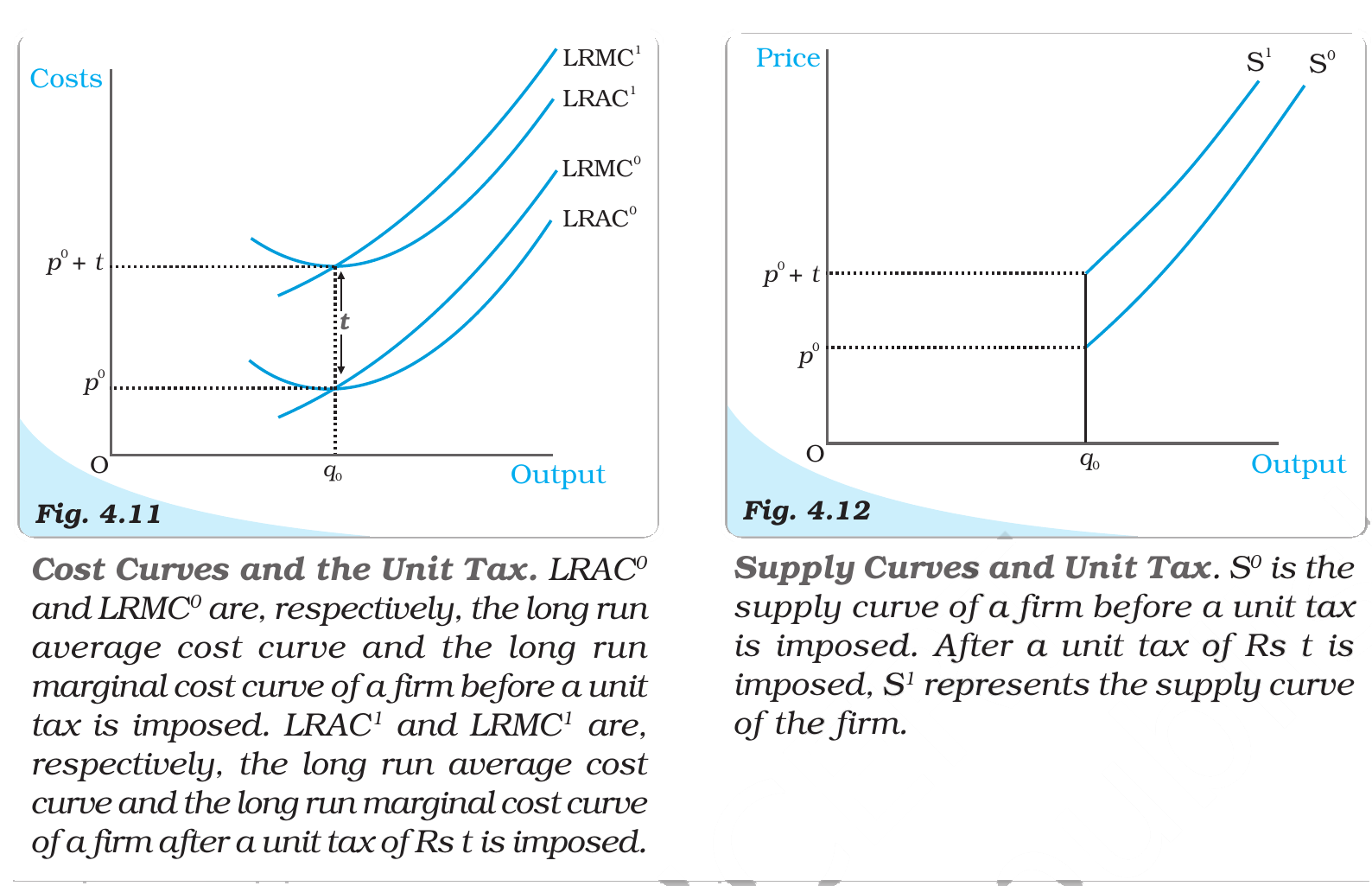
If additional unit tax imposed on goods by the government, then how it will affect the movement of supply curve?
Answer & explanation
Correct answer: option 1
The correct answer is Option (1) → Leftwards
A supply curve shows how much a firm offers for sale at each price. For a competitive firm it is the rising part of its marginal cost (MC) curve: the firm produces a unit only if the price covers the cost of that unit. A change in the good’s own price moves the firm along the curve; a change in anything else that affects cost, such as input prices, technology or a tax, shifts the whole curve.
A unit tax of Rs t has to be paid on every unit sold, so the cost of every unit rises by t and the MC curve moves up by t. The firm now needs a higher price for each quantity or, at any given price, offers less than before. So the supply curve shifts to the left (or upward).
Why the other options are incorrect
Option (2) Rightwards — Incorrect. The supply curve shifts to the right when costs fall, for example with better technology or a subsidy. A tax raises costs, so it has the opposite effect.
Option (3) No change — Incorrect. The tax is added to the cost of every unit sold. Higher costs change the quantity supplied at every price, so the curve does shift.
Option (4) Downwards — Incorrect. A downward shift would mean the same quantity is offered at a lower price, which happens when costs fall. A tax pushes the curve up, not down.
NCERT (2025-26): “Impact of a unit tax on supply … A unit tax is a tax that the government imposes per unit sale of output.… …Now, suppose the government puts in place a unit tax of Rs t. Since the firm must pay an extra Rs t for each unit of the good produced, the firm’s long run average cost and long run marginal cost at any level of output increases by Rs t.… …Notice that the unit tax shifts the firm’s long run supply curve to the left: at any given market price, the firm now supplies fewer units of output.…”
|