Choose the correct answer from the options given below:
(A) Election Commission of India was set up in November 1950
(B) India’s general election of 1952 became a landmark in the history of democracy all over the world.
(C) The founder President of the Bharatiya Jana Sangh was C. Rajagopalachari
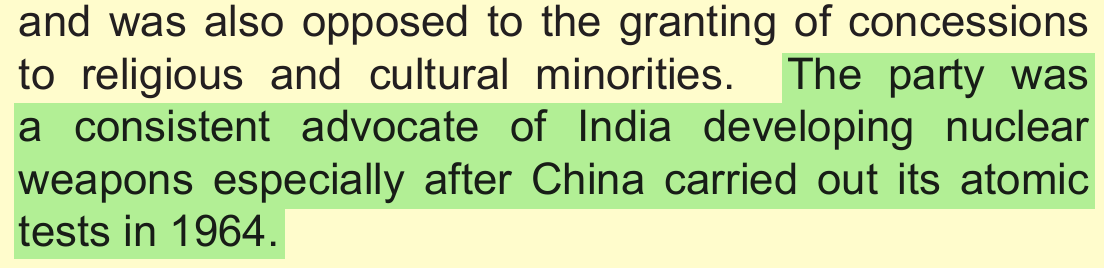
(D) The Bharatiya Jana Sangh Party was a consistent advocate of India developing nuclear weapons especially after China carried out its atomic test in 1964
(E) The Swatantra Party was formed in August 1969
Choose the correct answer from the options given below:
Answer & explanation
Correct answer: option 3
The correct answer is Option (3) → (B) and (D) only
(A) Election Commission of India was set up in November 1950 Incorrect. The Election Commission was set up in January 1950, with Sukumar Sen as the first Chief Election Commissioner.
(B) India’s general election of 1952 became a landmark in the history of democracy all over the world. Correct. After it, it was no longer possible to argue that democratic elections could not be held in conditions of poverty or lack of education.
(C) The founder President of the Bharatiya Jana Sangh was C. Rajagopalachari Incorrect. The Bharatiya Jana Sangh was formed in 1951 with Shyama Prasad Mukherjee as its founder-President; C. Rajagopalachari was one of the leaders of the Swatantra Party.
(D) The Bharatiya Jana Sangh Party was a consistent advocate of India developing nuclear weapons especially after China carried out its atomic test in 1964 Correct. The party consistently advocated nuclear weapons for India, especially after China’s atomic tests of 1964.
(E) The Swatantra Party was formed in August 1969 Incorrect. The Swatantra Party was formed in August 1959, after the Nagpur resolution of the Congress.
Note: The year of the Swatantra Party’s formation and its leaders are in the pre-rationalised NCERT, the book of this paper’s year; this portion has been deleted from subsequent editions of NCERT, including the NCERT book (2026-27), though the chapter is still there.
NCERT (2026-27): Politics in India since Independence — Chapter 2: Era of One-party Dominance
NCERT (2026-27): “Challenge of building democracy … The Constitution had laid down the rules, now the machine had to be put in place. Initially it was thought that this was only a matter of a few months. The Election Commission of India was set up in January 1950. Sukumar Sen became the first Chief Election Commissioner.… Challenge of building democracy … Observers outside India were equally impressed. India’s general election of 1952 became a landmark in the history of democracy all over the world. It was no longer possible to argue that democratic elections could not be held in conditions of poverty or lack of education.… Bharatiya Jana Sangh (BJS) … The Bharatiya Jana Sangh was formed in 1951 with Shyama Prasad Mukherjee as its founder-President. Its lineage however can be traced back to the Rashtriya Swayamsevak Sangh (RSS) and the Hindu Mahasabha before independence.…” NCERT (Pre-rationalised): “Swatantra Party … Swatantra Party was formed in August 1959 after the Nagpur resolution of the Congress which called for land ceilings, take-over of food grain trade by the state and adoption of cooperative farming. The party was led by old Congressmen like C. Rajagopalachari, K.M.Munshi, N.G.Ranga and Minoo Masani.…” |