
The figure shows a lead storage battery.
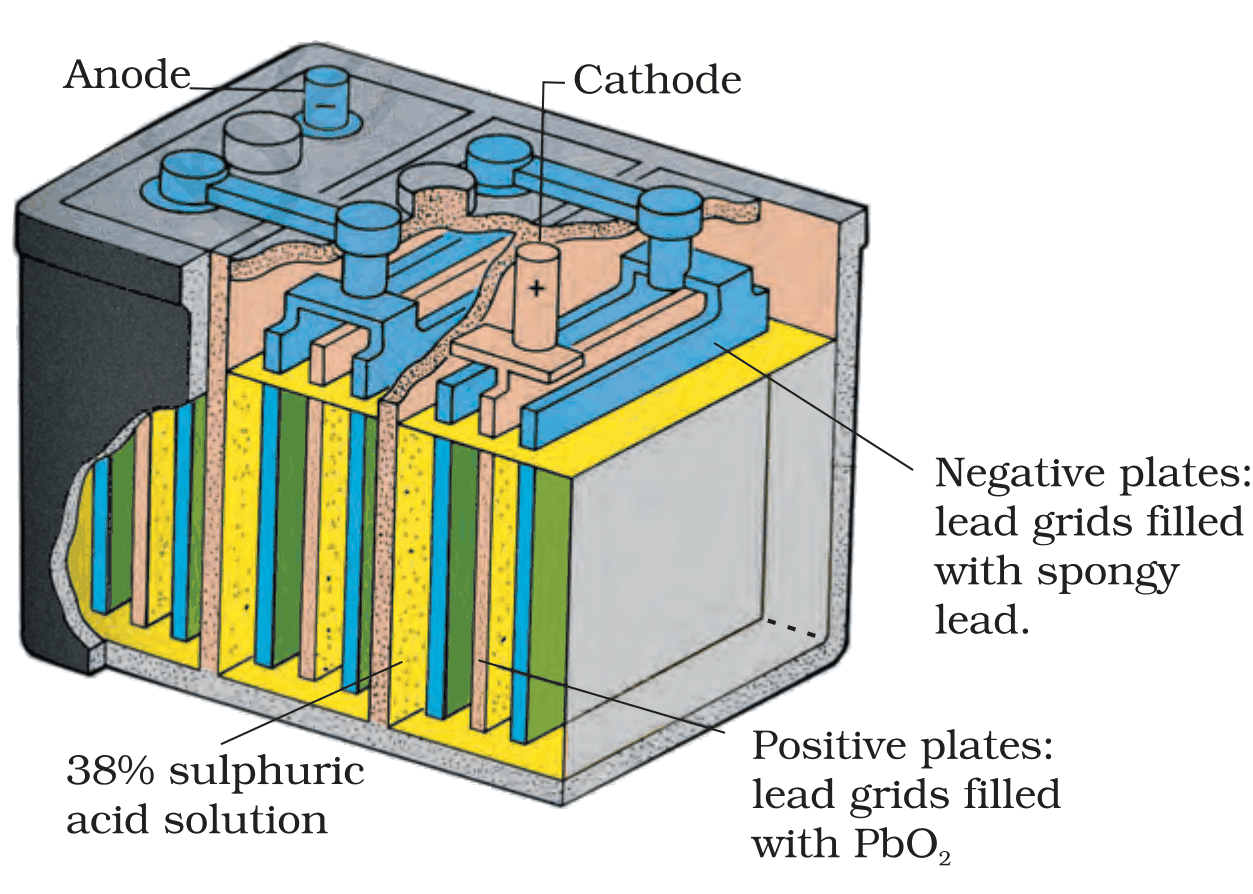
Which reaction takes place at the plates labelled ‘Negative plates’ while the battery is in use?
Answer & explanation
Correct answer: option 2
The correct answer is Option (2) → \( \ce{Pb(s) + SO4^2-(aq) -> PbSO4(s) + 2e^-} \)
The figure labels the negative plates as lead grids filled with spongy lead; these lead plates form the anode. While the battery is in use, lead is oxidised at the anode: it reacts with sulphate ions and gives lead sulphate and two electrons:
Anode: \( \ce{Pb(s) + SO4^2-(aq) -> PbSO4(s) + 2e^-} \)
Why the other options are incorrect
Option (1) \( \ce{PbO2(s) + SO4^2-(aq) + 4H^+(aq) + 2e^- -> PbSO4(s) + 2H2O(l)} \) — Incorrect. This reduction takes place at the positive plates (filled with PbO2, the cathode) while the battery is in use.
Option (3) \( \ce{PbSO4(s) + 2e^- -> Pb(s) + SO4^2-(aq)} \) — Incorrect. This is the reverse of the anode reaction; it takes place at the negative plates only when the battery is charged.
Option (4) \( \ce{PbSO4(s) + 2H2O(l) -> PbO2(s) + SO4^2-(aq) + 4H^+(aq) + 2e^-} \) — Incorrect. This takes place at the positive plates on charging, when PbSO4 is converted back into PbO2.
NCERT (2026-27 edition):
2.6.2 Secondary Batteries – “…The most important secondary cell is the lead storage battery (Fig. 2.10) commonly used in automobiles and invertors. It consists of a lead anode and a grid of lead packed with lead dioxide (PbO2) as cathode. A 38% solution of sulphuric acid is used as an electrolyte.”
“The cell reactions when the battery is in use are given below:”
Anode: Pb(s) + SO42–(aq) → PbSO4(s) + 2e–
Cathode: PbO2(s) + SO42–(aq) + 4H+(aq) + 2e– → PbSO4(s) + 2H2O(l)
“…On charging the battery the reaction is reversed and PbSO4(s) on anode and cathode is converted into Pb and PbO2, respectively.”
Fig. 2.10: The Lead storage battery.