
CUETMOCK
  • Pricing
  • Mentors
Log inStart freeStart free mocks→

First test, then trust

Try a free CUET mock test.

Join 5,00,000+ students who rehearsed exam day on the exact NTA screen before sitting CUET. On the web and on Android.

Start free mocks →Get the Android app
CUETMOCK

India's #1 CUET Mock Test Platform. Original NCERT-based questions on the exact NTA exam screen — trusted by 5,00,000+ students since CUET 2022.

Get it onGoogle PlayScan to download the CUETMOCK app

Mock tests

  • CUET mock test series
  • Commerce mocks
  • Humanities (Arts) mocks
  • Science mocks
  • Languages & GAT mocks
  • Free practice questions
  • Pricing

Resources

  • CUET exam guide
  • CUET syllabus
  • Universities accepting CUET
  • Expert blogs
  • News & notifications
  • Webinars & counselling
  • CUET score calculator
  • How we estimate your rank
  • FAQs

Company

  • About us
  • Our leadership & team
  • Our toppers
  • Mentors
  • For schools
  • Contact us
  • Terms
  • Privacy
  • Refund policy

Talk to us

+91 7696 6630 56info@cuetmock.comWhatsApp us

Our other platforms

  • JEE Mock — For IIT-JEE aspirants
  • NEET Mock — For NEET aspirants

Newsletter

Exam updates, study material and offers — no spam.

© 2026 NYC Ventures Pvt. Ltd.

701-702, Royal Business Park, Zirakpur, Punjab - 140603

  • Terms of use
  • Privacy policy
  • Refund policy
  • Contact us

iCUETMOCK is an independent preparation platform, not affiliated with the National Testing Agency (NTA). Always check exam details on the official NTA website.

  • Home
  • Mock tests
  • CUET guide
  • Pricing
  • Log in
Home/Practice questions/Chemistry
ChemistryOrganic: Haloalkanes and Haloarenes

The figure shows the reaction between chloromethane and hydroxide ion…

The figure shows the reaction between chloromethane and hydroxide ion, which follows second order kinetics.
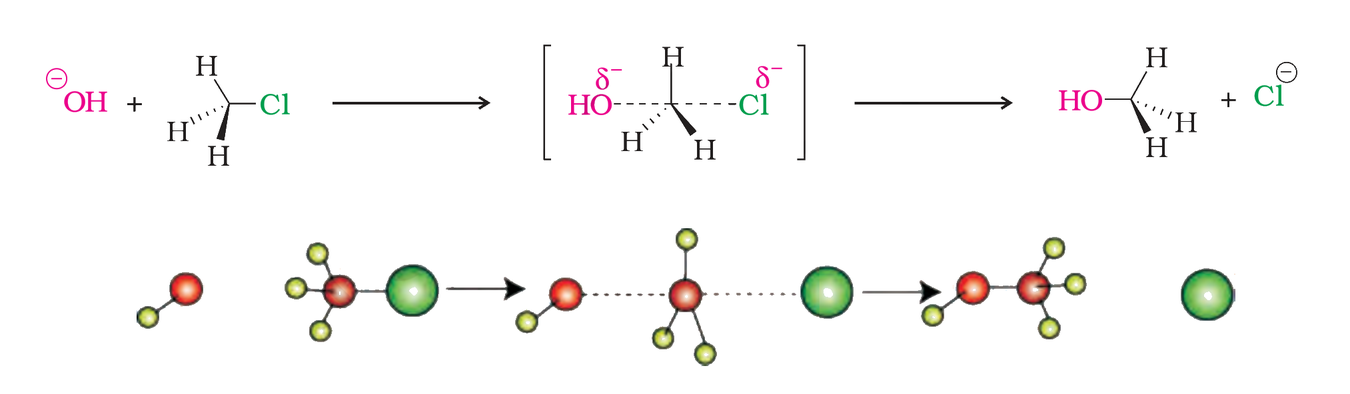
Fig. 6.2 Reaction of chloromethane with hydroxide ion

Which of the following correctly describes the species shown within the square brackets?

Answer & explanation+

Correct answer: option 2

The correct answer is Option (2) → It is a transition state, in which the carbon atom is bonded to five atoms at the same time.

  • A second order reaction of an alkyl halide goes by the SN2 mechanism: the C–O bond forms while the C–Cl bond breaks, in a single step, and no intermediate is formed.

  • In the bracketed species the dotted lines show the HO group and the Cl atom both partly attached to the same carbon, which also holds three H atoms lying in one plane.

  • The carbon is therefore bonded to five atoms at the same time, and the species is the transition state.

Why the other options are incorrect

Option (1) It is a carbocation intermediate, in which the carbon atom is bonded to three atoms. — Incorrect. A carbocation forms only in the SN1 mechanism; the bracketed carbon still has both HO and Cl partly attached.

Option (3) It is a stable intermediate that can be isolated, in which the carbon atom is bonded to five atoms. — Incorrect. A carbon with partial bonds to five atoms is unstable and cannot be isolated; the SN2 reaction forms no intermediate.

Option (4) It is a transition state, in which the carbon atom is bonded to four atoms. — Incorrect. Three H atoms, the O of the incoming OH and the outgoing Cl are all attached: five atoms, not four.

NCERT (2026-27 edition):
6.7.1 Reactions of Haloalkanes – “The reaction between CH3Cl and hydroxide ion to yield methanol and chloride ion follows a second order kinetics, i.e., the rate depends upon the concentration of both the reactants.”

“…These two processes take place simultaneously in a single step and no intermediate is formed. … In transition state all the three C-H bonds are in the same plane and the attacking and leaving nucleophiles are partially attached to the carbon. … Such structures are unstable and cannot be isolated. Thus, in the transition state, carbon is simultaneously bonded to five atoms.”

Fig. 6.2

Fig. 6.2: Red ball represents the incoming hydroxide ion and green ball represents the outgoing halide ion

Advertisement

Practise more on Organic: Haloalkanes and Haloarenes

Chapter-wise mocks on the real NTA exam screen, with solutions and your rank. Your first mocks are free.

Start free mocks →

Advertisement

Next questions

  1. The message of this picture is:Political Science · Contemporary World Politics: International Organisations
  2. On 1st April 2022, A, B and C decided to dissolve their firm On the date of dissolution, Sundry debtors appeared in Balance Sheet at Rs. 6,…Accountancy Part A · Dissolution of Partnership Firm
  3. Who is regarded as the father of India's space programme?General Aptitude Test · General Knowledge
  4. A charge +10 μC is placed at (0 mm, 0 mm) Another charge −5 μC is moved from (3 mm, 0 mm) to (0 mm, 3 mm). Work done by the external agency…Physics · Electrostatic Potential and Capacitance
  5. Given below are two statements: one is labelled as Assertion (A) and the other is labelled as Reason (R). Assertion (A): Management by exce…Business Studies · Controlling
  6. In the given question, a statement of Assertion is followed by a statement of Reason. Mark the correct answer.Assertion: Political Parties…Political Science · Contemporary World Politics: Contemporary South Asia
  7. What is the meaning of the Latin term "amicus curie"?Legal Studies · Legal Maxims
  8. Sentences of a paragraph are given below in jumbled order. Arrange the sentences in the right order to form a meaningful and coherent parag…English · Arrange in Meaningful Sequence
  9. कार्यालयी पत्र में 'संदर्भ' के अंतर्गत क्या लिखा जाता है?Hindi · पत्र लेखन
  10. The area of a table top in the shape of an equilateral triangle is 9√3 cm2. What is the length (in cm) of each side of the table?General Aptitude Test · Quantitative Reasoning