
Read the passage and answer the following questions:
The initial clue about the genetic/chromosomal mechanism of sex determination can be traced back to some of the experiments carried out in insects. Henking (1891) could trace a specific nuclear structure all through spermatogenesis in a few insects, and it was also observed by him that 50 per cent of the sperm received this structure after spermatogenesis, whereas the other 50 per cent sperm did not receive it. Henking gave a name to this structure as the X body but he could not explain its significance. Further investigations by other scientists led to the conclusion that the 'X body' of Henking was in fact a chromosome and that is why it was given the name X-chromosome. Due to the involvement of the X-chromosome in the determination of sex, it was designated to be the sex chromosome, and the rest of the chromosomes were named as autosomes.
Choose the correct statements from the following:
A. In honey bee, an unfertilised egg develops as a male (drone) by means of parthenogenesis.
B. In honey bee, the males produce sperms by meiosis.
C. In honey bee, a male cannot have sons but can have grandsons.
D. In honey bee, an offspring formed from the union of a sperm and an egg develops as a drone.
Choose the correct answer from the options given below:
Answer & explanation
Correct answer: option 2
The correct answer is Option (2) → A and C only
Sex in the honey bee depends on the number of sets of chromosomes. A fertilised egg is diploid (32 chromosomes) and becomes a female. An unfertilised egg is haploid (16 chromosomes) and becomes a male. This is the haplodiploid sex-determination system.
A. In honey bee, an unfertilised egg develops as a male (drone) by means of parthenogenesis. — True. Parthenogenesis is the development of an egg without fertilisation. The unfertilised egg keeps one set of 16 chromosomes and develops into a drone.
B. In honey bee, the males produce sperms by meiosis. — False. The drone is already haploid, so its chromosome number cannot be halved again. The males produce sperms by mitosis, not meiosis (Figure 4.13).
C. In honey bee, a male cannot have sons but can have grandsons. — True. A male comes from an unfertilised egg, so he has no father. His sperm only fertilise eggs, and fertilised eggs give females, so he cannot have sons. His daughters can lay unfertilised eggs, so he can have grandsons.
D. In honey bee, an offspring formed from the union of a sperm and an egg develops as a drone. — False. The union of a sperm and an egg gives a diploid zygote, which develops as a female (queen or worker). A drone comes only from an unfertilised egg.
NCERT Extract:
Sex Determination in Honey Bee – “The sex determination in honey bee is based on the number of sets of chromosomes an individual receives. An offspring formed from the union of a sperm and an egg develops as a female (queen or worker), and an unfertilised egg develops as a male (drone) by means of parthenogenesis. This means that the males have half the number of chromosomes than that of a female. The females are diploid having 32 chromosomes and males are haploid, i.e., having 16 chromosomes. This is called as haplodiploid sex-determination system and has special characteristic features such as the males produce sperms by mitosis (Figure 4.13), they do not have father and thus cannot have sons, but have a grandfather and can have grandsons.”
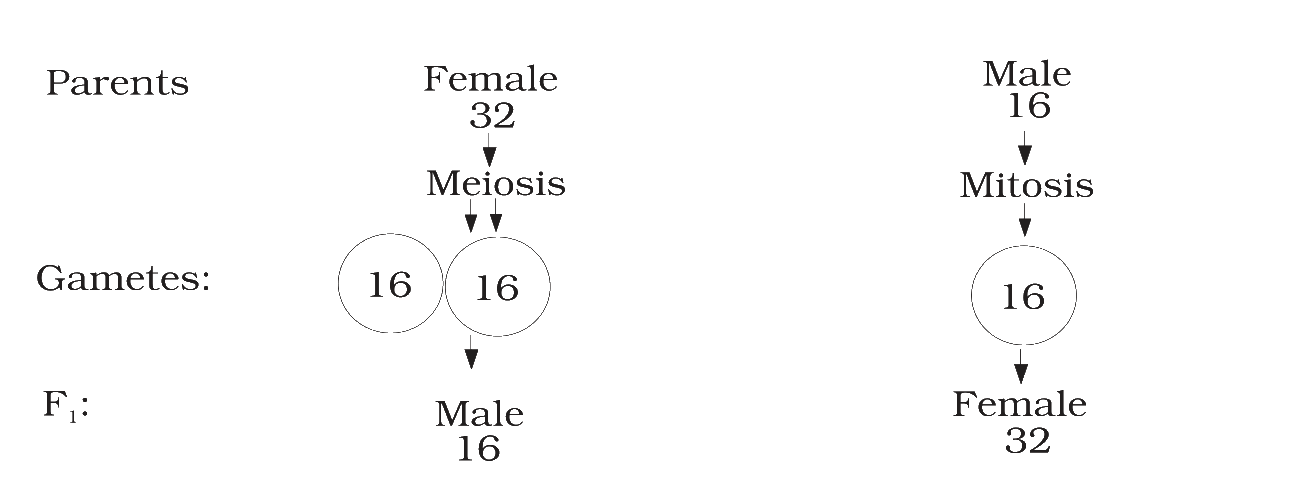
Figure 4.13 Sex determination in honey bee