
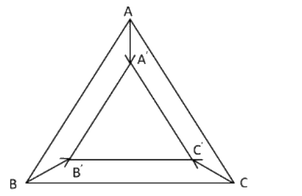
Three point charges (Q) having the same magnitude and nature, are placed at three vertices of an equilateral triangle ABC of side l each as shown in the figure. The change in potential energy of the system of these three charges when they are shifted to form a smaller triangle A'B'C' of side l/2 is given by:
[Here k = 1/(4πε0)]
Answer & explanation
Correct answer: option 1
The correct answer is Option (1) → 3kQ2/l
The potential energy of a system of charges is the sum over all pairs, \( U = \sum kq_iq_j/r_{ij} \). An equilateral triangle has three pairs, all at the same separation.
\( \displaystyle U_{\mathrm{initial}} = 3\,\frac{kQ^{2}}{l} \)
\( \displaystyle U_{\mathrm{final}} = 3\,\frac{kQ^{2}}{l/2} = 6\,\frac{kQ^{2}}{l} \)
\( \displaystyle \Delta U = U_{\mathrm{final}} - U_{\mathrm{initial}} = \frac{3kQ^{2}}{l} \)
The change is positive: work must be done against the repulsion to bring like charges closer.
Shortcut: U is proportional to 1/l, so halving the side doubles U; the change equals the initial energy, \( 3kQ^{2}/l \).