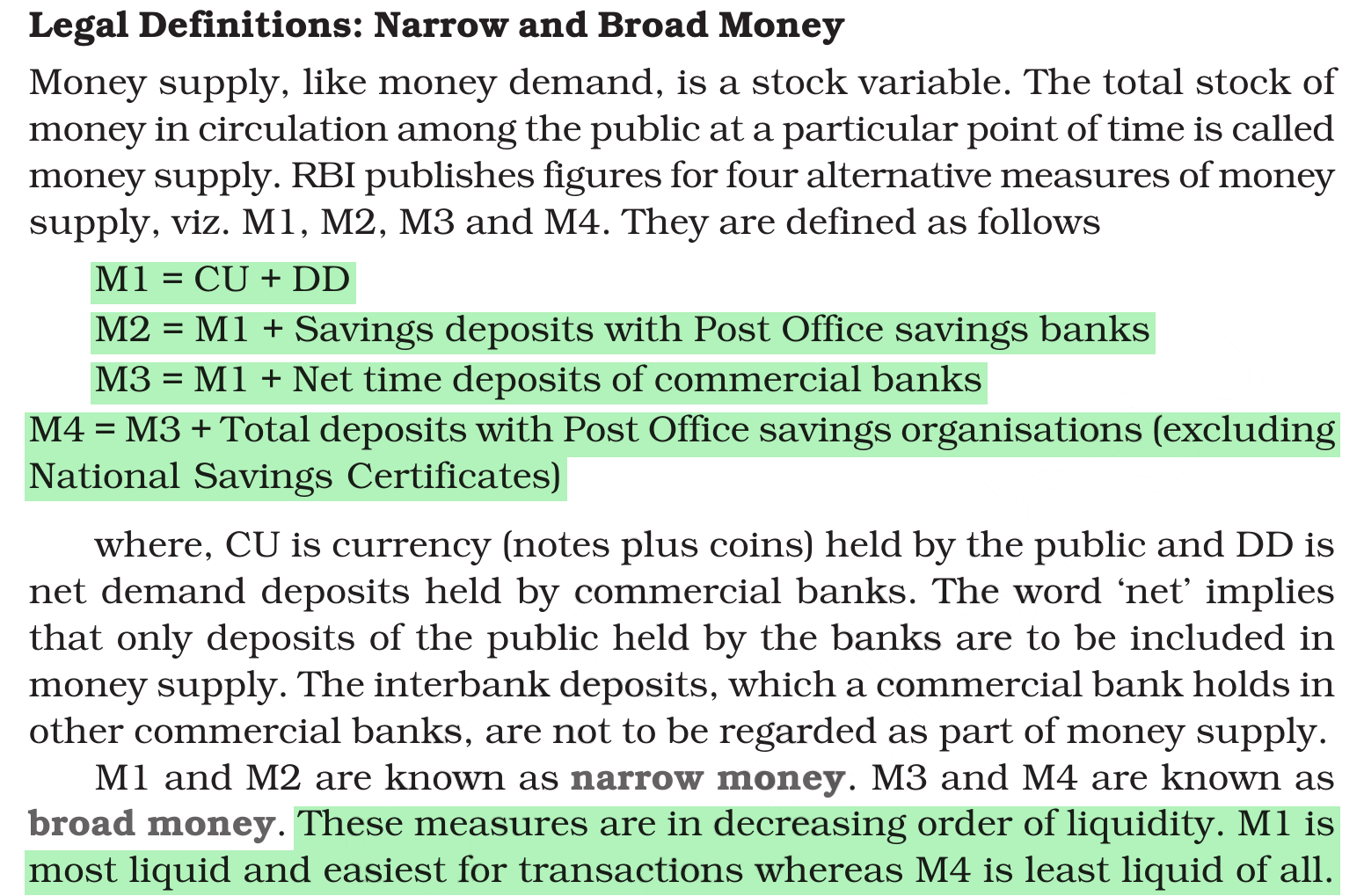
Arrange the following measures of money supply in decreasing order of liquidity.
(A) M1 + Net time deposits of commercial banks
(B) M1 + Savings deposits with Post Office savings banks
(C) M3 + Total deposits with Post Office savings organisations (excluding National Savings Certificates)
(D) Currency + Demand Deposit
Choose the correct answer from the options given below:
Answer & explanation
Correct answer: option 4
The correct answer is Option (4) → (D), (B), (A), (C)
An asset’s liquidity is the ease with which it can be used for transactions: currency and demand deposits can be spent at once, while savings and time deposits take longer to turn into spending. Each measure of money supply adds a less liquid asset to the one before, so M1 is the most liquid and M4 the least.
(D) Currency + Demand Deposit — M1: currency held by the public plus net demand deposits held by commercial banks. Both can be spent at once, so this is the most liquid measure; M1 and M2 are called narrow money.
(B) M1 + Savings deposits with Post Office savings banks — M2: M1 plus savings deposits with post office savings banks. These deposits are not as freely usable for payments as currency and demand deposits.
(A) M1 + Net time deposits of commercial banks — M3: M1 plus net time deposits of commercial banks. Time deposits are held for a fixed period, so they are less liquid again; M3 is called broad money.
(C) M3 + Total deposits with Post Office savings organisations (excluding National Savings Certificates) — M4: M3 plus total deposits with post office savings organisations (excluding National Savings Certificates). It includes every deposit of the earlier measures and more, so it is the least liquid.
Note: A same/similar question was asked in CUET (UG) in the papers below.
| 2026 | 2025 | 2024 | 2023 | 2022 |
| 12-05 S1* 19-05 S2* 07-06 S2 | 13-05 S2* | – | – | – |
* A similar question.
NCERT: Introductory Macroeconomics — Chapter 3: Money and Banking (2025-26)
|