CUETMOCK
  • Pricing
  • Mentors
Log inStart freeStart free mocks→

First test, then trust

Try a free CUET mock test.

Join 5,00,000+ students who rehearsed exam day on the exact NTA screen before sitting CUET. On the web and on Android.

Start free mocks →Get the Android app
CUETMOCK

India's #1 CUET Mock Test Platform. Original NCERT-based questions on the exact NTA exam screen — trusted by 5,00,000+ students since CUET 2022.

Get it onGoogle PlayScan to download the CUETMOCK app

Mock tests

  • CUET mock test series
  • Browse all papers
  • Commerce mocks
  • Humanities (Arts) mocks
  • Science mocks
  • Languages & GAT mocks
  • Free practice questions
  • Pricing

Resources

  • CUET exam guide
  • CUET syllabus
  • Universities accepting CUET
  • Expert blogs
  • News & notifications
  • Webinars & counselling
  • CUET score calculator
  • How we estimate your rank
  • FAQs

Company

  • About us
  • Our leadership & team
  • Our toppers
  • Mentors
  • For schools
  • Contact us
  • Terms
  • Privacy
  • Refund policy

Talk to us

+91 7696 6630 56info@cuetmock.comWhatsApp us

Our other platforms

  • JEE Mock — For IIT-JEE aspirants
  • NEET Mock — For NEET aspirants

Newsletter

Exam updates, study material and offers — no spam.

© 2026 NYC Ventures Pvt. Ltd.

701-702, Royal Business Park, Zirakpur, Punjab - 140603

  • Terms of use
  • Privacy policy
  • Refund policy
  • Contact us

iCUETMOCK is an independent preparation platform, not affiliated with the National Testing Agency (NTA). Always check exam details on the official NTA website.

  • Home
  • Mock tests
  • CUET guide
  • Pricing
  • Log in
Home/Practice questions/History
HistoryAncient India: Kings, Farmers and Towns

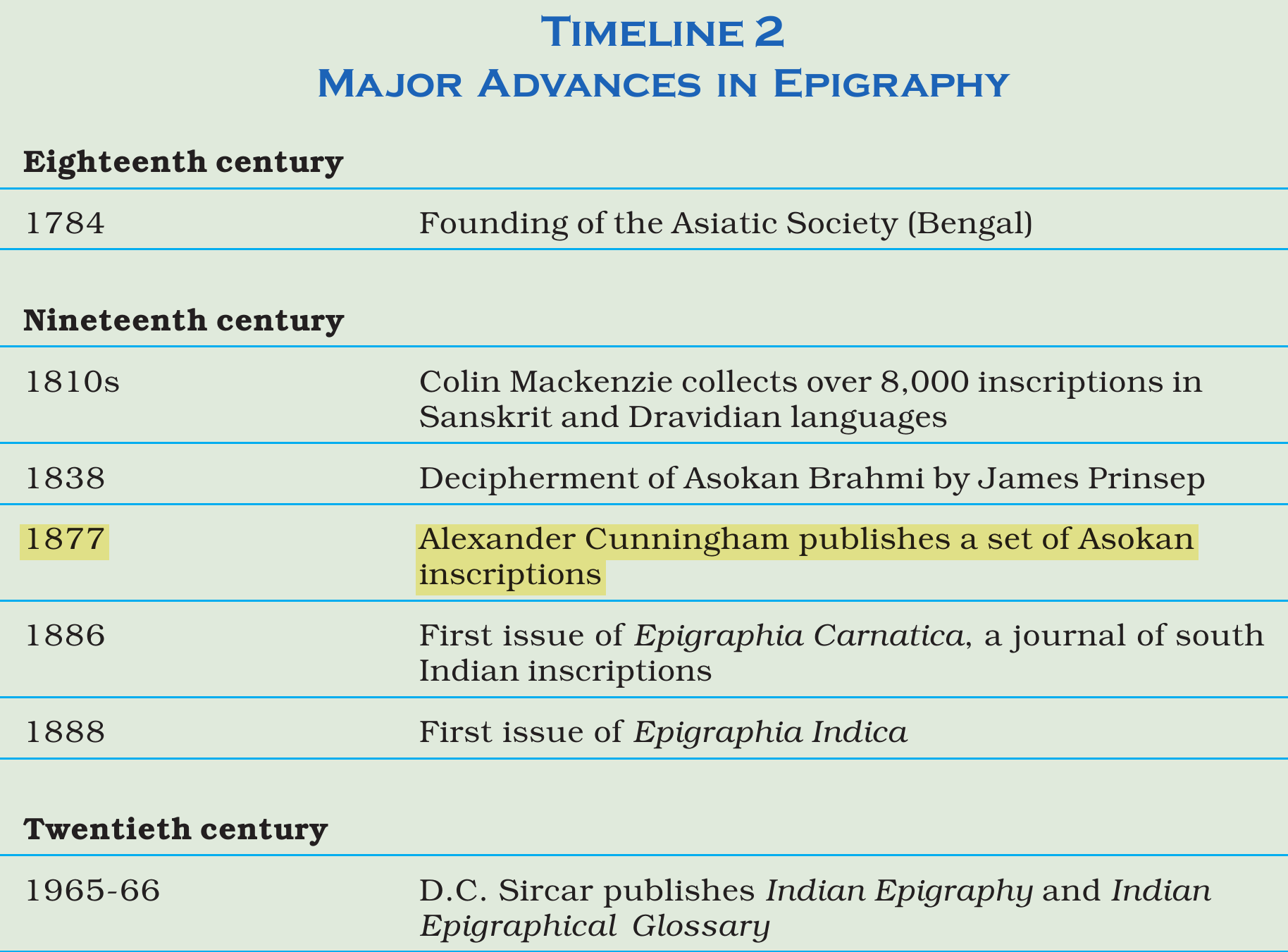
When did Alexander Cunningham publish a set of Ashokan Inscriptions?

When did Alexander Cunningham publish a set of Ashokan Inscriptions?

Answer & explanation+

Correct answer: option 4

The correct answer is Option (4) → 1877

The timeline of major advances in epigraphy records that in 1877 Alexander Cunningham published a set of Asokan inscriptions.


NCERT: Themes in Indian History Part I — Chapter 2: Kings, Farmers and Towns (2026-27)

NCERT extract

Advertisement

Practise more on Ancient India: Kings, Farmers and Towns

Chapter-wise mocks on the real NTA exam screen, with solutions and your rank. Your first mocks are free.

Start free mocks →

Advertisement

Next questions

  1. If f(x)= […] is continuous at x = 0, thenMaths. Section B1 · Continuity and Differentiability
  2. Which of the following geographers described the 'state/country' as a 'living organism'?Geography · Fundamentals of Human Geography: Human Geography-Nature and Scope
  3. This policy refers to allowing large-scale industries to produce goods and services which were produced only by the small-scale industries.…Economics · Indian Economic Development: Liberalisation, Privatisation and Globalisation - An Appraisal
  4. Identify A and B in the picture.Biology · Biotechnology and its Applications
  5. Average of a and b is 36. Average of b and c is 42. What is the difference between c and a?General Aptitude Test · Numerical Ability
  6. Phenol reacts with sodium hydroxide and carbon dioxide in acidic medium to produceChemistry · Organic: Alcohols, Phenols and Ethers
  7. Sunil purchased a fan at a 10% discount on the labelled price. If he had purchased it at a 15% discount, he would have saved ₹400. Find the…General Aptitude Test · Numerical Ability
  8. The area of a trapezium is 432 cm2, if its parallel sides are in the ratio 3 : 5 and the perpendicular distance between them is 12 cm, the…General Aptitude Test · Quantitative Reasoning
  9. Arrange the following agricultural regions from equator to pole: (A) Commercial grain farming in the Prairies(B) Reindeer rearing by the Es…Geography · Fundamentals of Human Geography: Primary Activities
  10. A candle flame 3cm is placed at distance of 3m from a wall. How far from wall must a concave mirror be placed in order that it may form an…Physics · Ray Optics