Phenol reacts with sodium hydroxide and carbon dioxide in acidic medium to produce
Answer & explanation
Correct answer: option 3
The correct answer is Option (3) → Salicylic acid
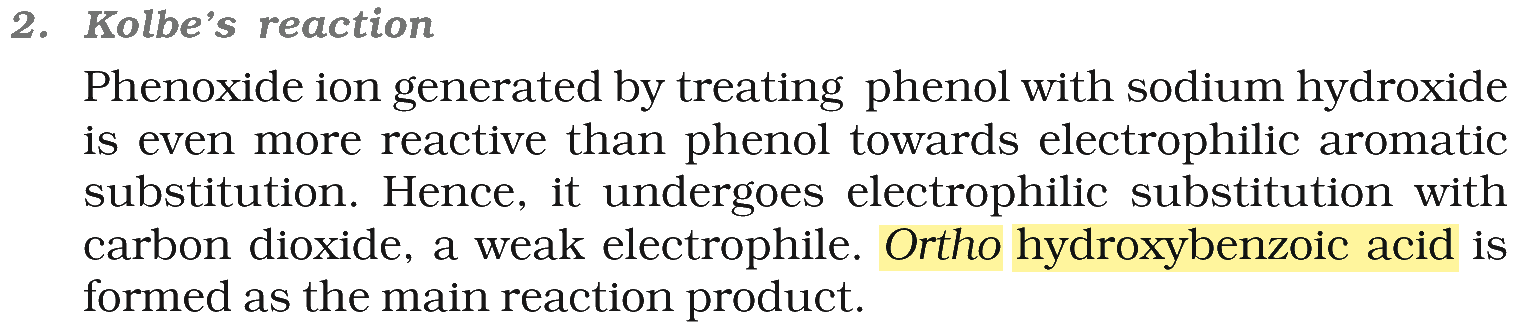
This is Kolbe’s reaction. Phenol is first converted by NaOH into the phenoxide ion, which is even more reactive than phenol towards electrophilic substitution. It is attacked by carbon dioxide, a weak electrophile, mainly at the ortho position; acidification of the sodium salt then gives ortho-hydroxybenzoic acid (salicylic acid):
\( \ce{C6H5OH + NaOH -> C6H5ONa + H2O} \)
\( \ce{C6H5ONa} \xrightarrow[\text{400 K, 4-7 atm}]{\ce{CO2}} \underset{\text{sodium salicylate}}{\ce{HOC6H4COONa}} \)
\( \ce{HOC6H4COONa} \xrightarrow{\ce{H+}} \underset{\text{salicylic acid}}{\ce{HOC6H4COOH}} \)
Why the other options are incorrect
Option (1) Benzoic acid — Incorrect. \( \ce{C6H5COOH} \) has no OH group; the OH of phenol stays on the ring in Kolbe’s reaction.
Option (2) Salicylaldehyde — Incorrect. It is formed in the Reimer-Tiemann reaction, where phenol is treated with chloroform and NaOH and a –CHO group enters the ortho position.
Option (4) Phthalic acid — Incorrect. Benzene-1,2-dicarboxylic acid has two COOH groups and no OH; it is obtained by oxidation of o-xylene, not from phenol.
NCERT (2026-27 edition):
Kolbe’s Reaction