
CUETMOCK
  • Pricing
  • Mentors
Log inStart freeStart free mocks→

First test, then trust

Try a free CUET mock test.

Join 5,00,000+ students who rehearsed exam day on the exact NTA screen before sitting CUET. On the web and on Android.

Start free mocks →Get the Android app
CUETMOCK

India's #1 CUET Mock Test Platform. Original NCERT-based questions on the exact NTA exam screen — trusted by 5,00,000+ students since CUET 2022.

Get it onGoogle PlayScan to download the CUETMOCK app

Mock tests

  • CUET mock test series
  • Commerce mocks
  • Humanities (Arts) mocks
  • Science mocks
  • Languages & GAT mocks
  • Free practice questions
  • Pricing

Resources

  • CUET exam guide
  • CUET syllabus
  • Universities accepting CUET
  • Expert blogs
  • News & notifications
  • Webinars & counselling
  • CUET score calculator
  • How we estimate your rank
  • FAQs

Company

  • About us
  • Our leadership & team
  • Our toppers
  • Mentors
  • For schools
  • Contact us
  • Terms
  • Privacy
  • Refund policy

Talk to us

+91 7696 6630 56info@cuetmock.comWhatsApp us

Our other platforms

  • JEE Mock — For IIT-JEE aspirants
  • NEET Mock — For NEET aspirants

Newsletter

Exam updates, study material and offers — no spam.

© 2026 NYC Ventures Pvt. Ltd.

701-702, Royal Business Park, Zirakpur, Punjab - 140603

  • Terms of use
  • Privacy policy
  • Refund policy
  • Contact us

iCUETMOCK is an independent preparation platform, not affiliated with the National Testing Agency (NTA). Always check exam details on the official NTA website.

  • Home
  • Mock tests
  • CUET guide
  • Pricing
  • Log in
Home/Practice questions/Chemistry
ChemistryPhysical: Chemical Kinetics

Consider the following statements about the units of the rate constan…

Consider the following statements about the units of the rate constant, k, when concentration is expressed in mol L−1 and time in seconds.

(A) For a zero order reaction, the units of k are the same as the units of the rate of the reaction.

(B) For a first order reaction, the units of k are s−1.

(C) For a reaction of order n, the units of k are (mol L−1)n−1 s−1.

(D) For a second order reaction, the units of k are mol−1 L s−1.

Which of the statements given above are correct? Choose the correct answer from the options given below:

Answer & explanation+

Correct answer: option 1

The correct answer is Option (1) → (A), (B) and (D) only

For a reaction of order n, Rate = k(concentration)n, so the units of k are found by dividing the units of rate by (mol L−1)n:

    \( \displaystyle k = \frac{\mathrm{mol\,L^{-1}\,s^{-1}}}{(\mathrm{mol\,L^{-1}})^{n}} = (\mathrm{mol\,L^{-1}})^{1-n}\,\mathrm{s^{-1}} \)

(A) For a zero order reaction, the units of k are the same as the units of the rate of the reaction. — True. With n = 0, k has the units mol L−1 s−1, which are the units of rate; for a zero order reaction, rate = k.

(B) For a first order reaction, the units of k are s−1. — True. With n = 1, the concentration units cancel and only s−1 is left.

(C) For a reaction of order n, the units of k are (mol L−1)n−1 s−1. — False. The power is 1 − n, not n − 1. For a zero order reaction the false form would give mol−1 L s−1 instead of mol L−1 s−1.

(D) For a second order reaction, the units of k are mol−1 L s−1. — True. With n = 2, (mol L−1)−1 s−1 = mol−1 L s−1.

NCERT (2026-27 edition):
3.1 Rate of a Chemical Reaction – “…if concentration is in mol L–1 and time is in seconds then the units will be mol L-1s–1.”

3.2.3 Order of a Reaction – “Taking SI units of concentration, mol L–1 and time, s, the units of k for different reaction order are listed in Table 3.3”
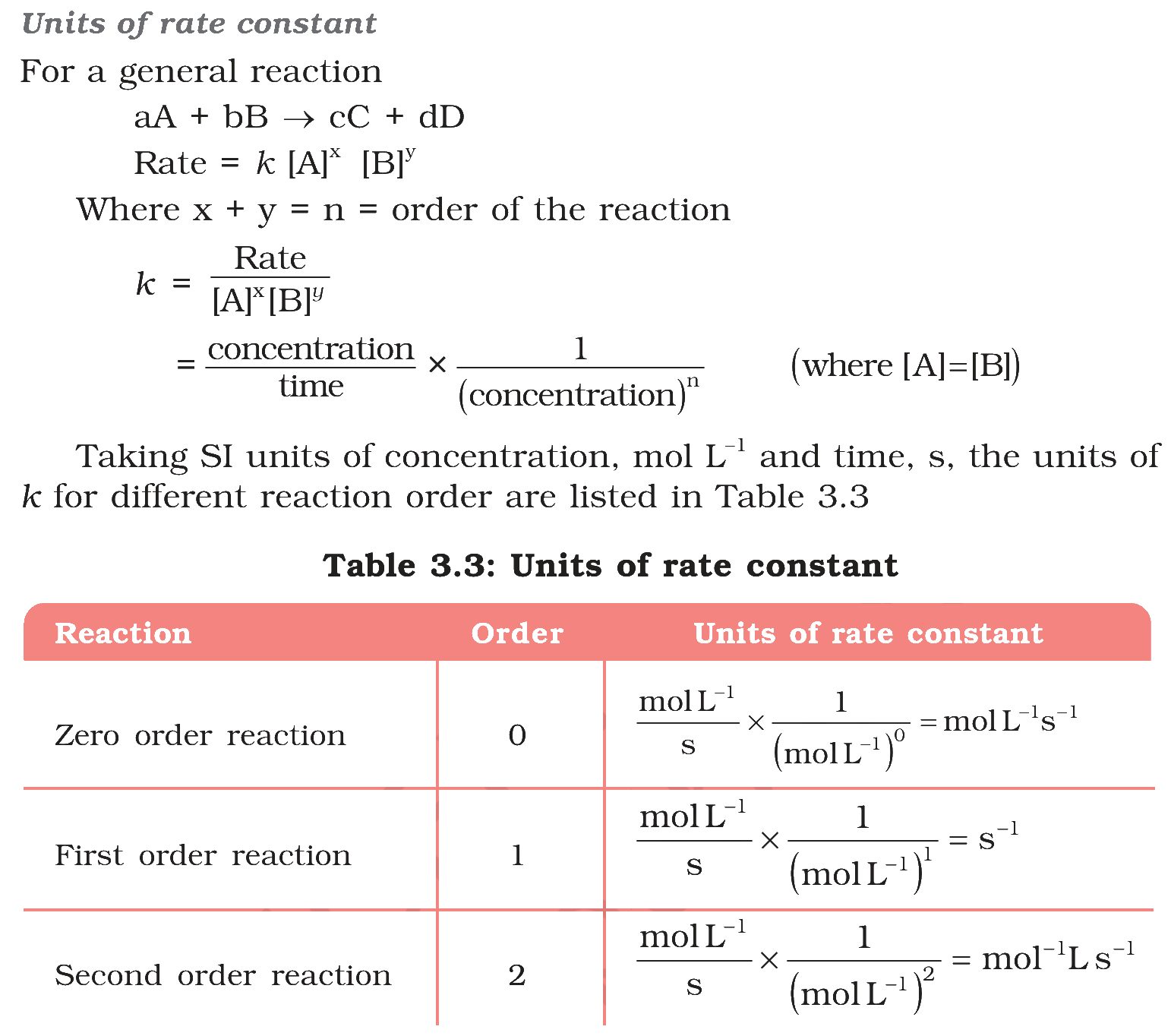
Units of rate constant and Table 3.3

Advertisement

Practise more on Physical: Chemical Kinetics

Chapter-wise mocks on the real NTA exam screen, with solutions and your rank. Your first mocks are free.

Start free mocks →

Advertisement

Next questions

  1. Arrange the following needs of Maslow's need hierarchy theory in reverse chronological order. (A) Security needs(B) Esteem needs(C) Self ac…Business Studies · Directing
  2. A and B takes 51/3 days and 81/3 days more for doing a piece of work respectively than the time taken by A and B together. In how many days…General Aptitude Test · Numerical Ability
  3. Management contains a series of interrelated functions that include.................... functions.Business Studies · Nature and significance of Management
  4. Match List - I with List - II. List - I List - II (A) Polyvinyl chloride (I) Phenol formaldehyde (B) Urea-formaldehyde (II) Ethyleneglycol…Chemistry · Organic: Polymers
  5. The early nineteenth-century painting shown above depicts which of the following scenes?History · Medieval India: Peasants, Zamindars and the State
  6. The balance, if any, left in the share forfeited account relating to reissued shares, should be transferred to....Accountancy Part A · Accounting for Shares
  7. An electric dipole is made of charges +5\ nC and -5\ nC placed 2 mm apart. Points A and B are each 3 cm from the centre of the dipole. A li…Physics · Electrostatic Potential and Capacitance
  8. Choose a word that comes fourth in according to English dictionary from the following four words: 1. dfhdfjvdaskjdsj, 2. dfhdfjudaskldsj, 3…General Aptitude Test · Verbal Reasoning
  9. Babur ruled over Delhi till ______ year.General Aptitude Test · General Knowledge
  10. What is the name of the painting shown above?Fine Arts · The Rajasthani Schools of Painting