
Match List - I with List - II.
| List - I | List - II |
| (A) Polyvinyl chloride | (I) Phenol formaldehyde |
| (B) Urea-formaldehyde | (II) Ethyleneglycol and phthalic acid |
| (C) Glyptal | (III) Vinyl chloride |
| (D) Bakelite | (IV) Urea-formaldehyde |
Choose the correct answer from the options given below:
Answer & explanation
Correct answer: option 1
The correct answer is option 1. (A)-(III), (B)-(IV), (C)-(II), (D)-(I).
| List - I | List - II |
| (A) Polyvinyl chloride | (III) Vinyl chloride |
| (B) Urea-formaldehyde | (IV) Urea-formaldehyde |
| (C) Glyptal | (II) Ethyleneglycol and phthalic acid |
| (D) Bakelite | (I) Phenol formaldehyde |
Let us delve into the details of each polymer and its corresponding components to understand the matching process.
(A) Polyvinyl chloride(III) Vinyl chloride
Polyvinyl chloride is a widely used synthetic polymer, commonly known as PVC. It is utilized in a variety of applications, from piping to flooring and medical devices. The monomer used to produce PVC is vinyl chloride. During the polymerization process, multiple vinyl chloride molecules are chemically bonded together to form the long polymer chain of PVC.

(B) Urea-formaldehyde(IV) Urea-formaldehyde
Urea-formaldehyde is a type of thermosetting polymer known for its strong bonding properties and is used in adhesives, finishes, and molded objects.
Components: The resin is synthesized from urea and formaldehyde. The reaction between these two substances produces a polymer that cross-links to form a rigid and durable material.

(C) Glyptal(II) Ethyleneglycol and phthalic acid
Glyptal is a type of polyester resin used in coatings and paints due to its hardness and resistance to chemicals.
Glyptal is made by the reaction of ethylene glycol and phthalic acid. This reaction produces a polymer with ester linkages, which contribute to its properties.

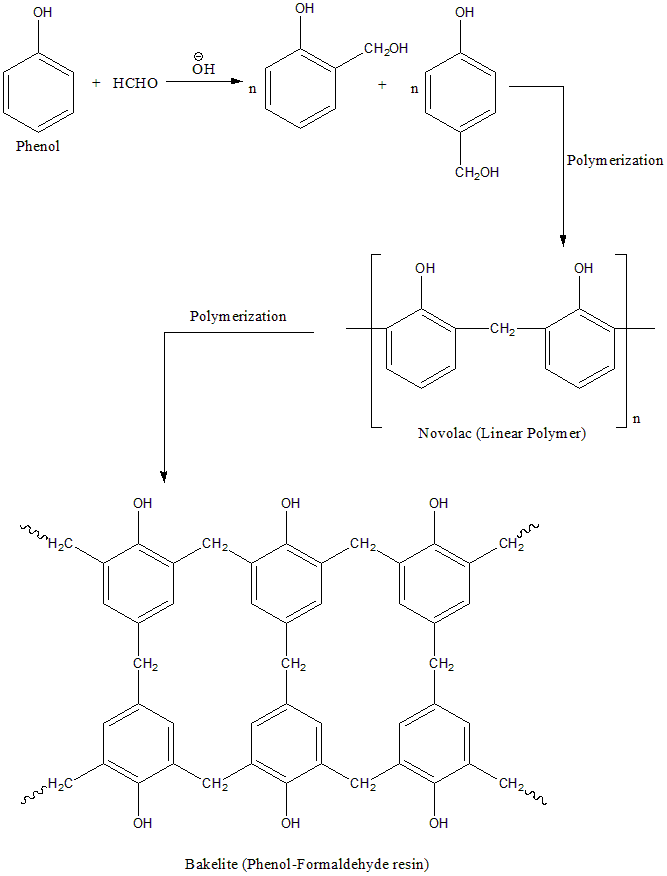
(D) Bakelite(I) Phenol formaldehyde
Bakelite is one of the earliest synthetic polymers and is known for its electrical insulating properties and heat resistance. It is commonly used in electrical appliances, handles, and other durable goods. Bakelite is produced from phenol and formaldehyde. The polymerization of these two chemicals forms a cross-linked network structure.
The correct option is (1): (A)-(III), (B)-(IV), (C)-(II), (D)-(I).