Carboxylic acids having an α-hydrogen are halogenated at the α-position on treatment with chlorine or bromine in the presence of small amount of red phosphorus to give α-halocarboxylic acids. The reaction is known as Hell-Volhard-Zelinsky reaction.

α-Bromopropionic acid is treated with aqueous alkali, which replaces the bromine atom. What is the product?
Answer & explanation
Correct answer: option 2
The correct answer is Option (2) → Lactic acid (α-hydroxypropionic acid)
In the passage, the Hell-Volhard-Zelinsky reaction puts a halogen on the α-carbon of a carboxylic acid. α-Bromopropionic acid (2-bromopropanoic acid) is \( \ce{CH3-CH(Br)-COOH} \): the bromine sits on an sp3 carbon, so it reacts like a haloalkane.
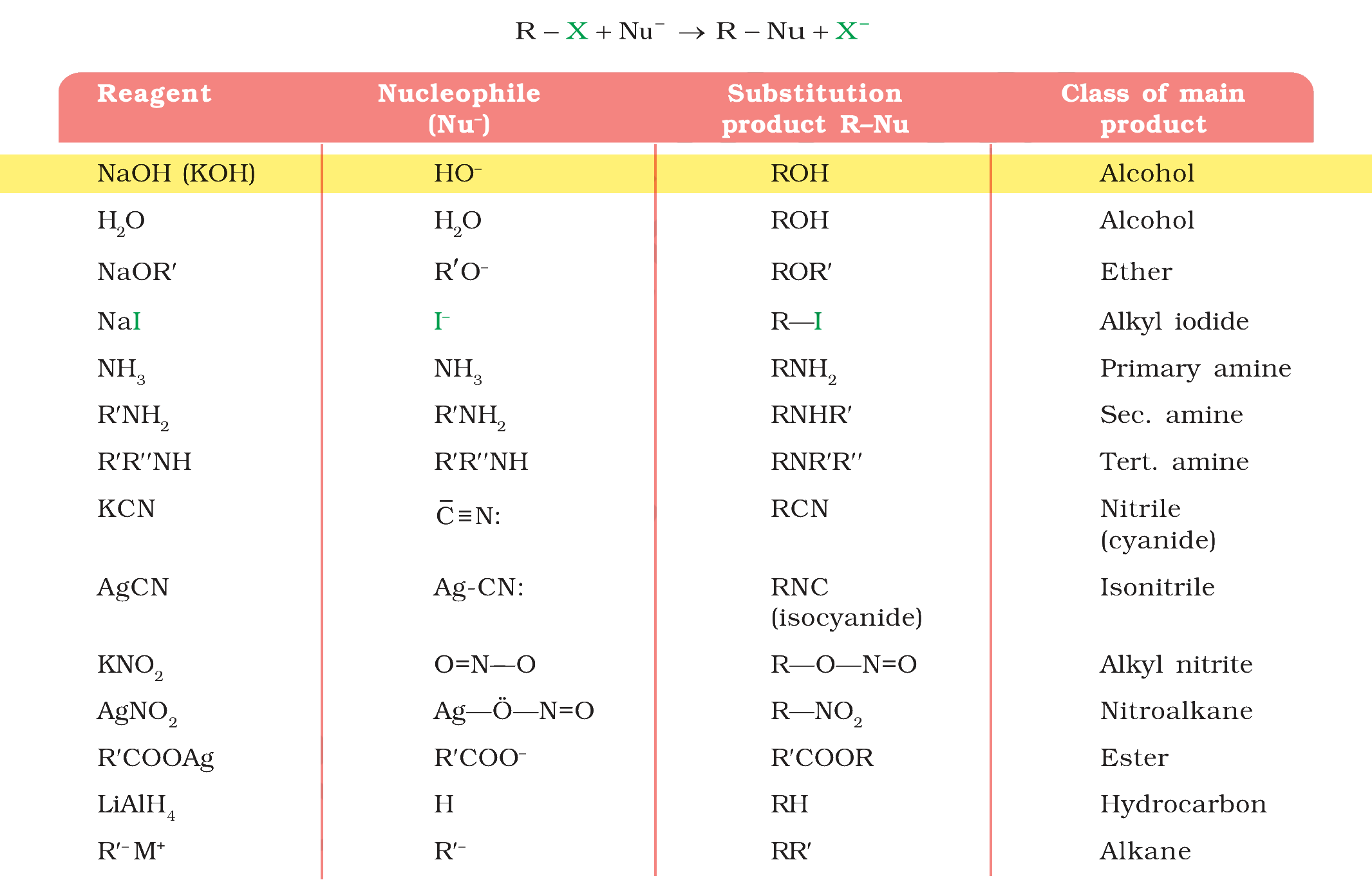
With aqueous alkali, the hydroxide ion acts as the nucleophile and replaces the bromine (nucleophilic substitution), as an alkyl halide gives an alcohol:
\( \displaystyle \ce{CH3-CH(Br)-COOH + KOH} \xrightarrow{\text{aq}} \ce{CH3-CH(OH)-COOH + KBr} \)
The product, 2-hydroxypropanoic acid, is lactic acid. (In the alkali the –COOH group is present as its salt; acidification sets the acid free.)
Why the other options are incorrect
Option (1) Acrylic acid — Incorrect. \( \ce{CH2=CH-COOH} \) comes from elimination of HBr, which takes place with alcoholic KOH, not with aqueous alkali.
Option (3) α-Aminopropionic acid — Incorrect. An amino group comes in only when ammonia is the nucleophile; here the nucleophile is \( \ce{OH^-} \).
Option (4) α,α-Dibromopropionic acid — Incorrect. The alkali removes the bromine; it cannot add a second bromine atom.
NCERT (2026-27 edition):
Table 6.4: Nucleophilic Substitution of Alkyl Halides (R–X)