Downward swing of Aggregate Demand (AD) line is described as :
Answer & explanation
Correct answer: option 4
The correct answer is Option (4) → Paradox of Thrift
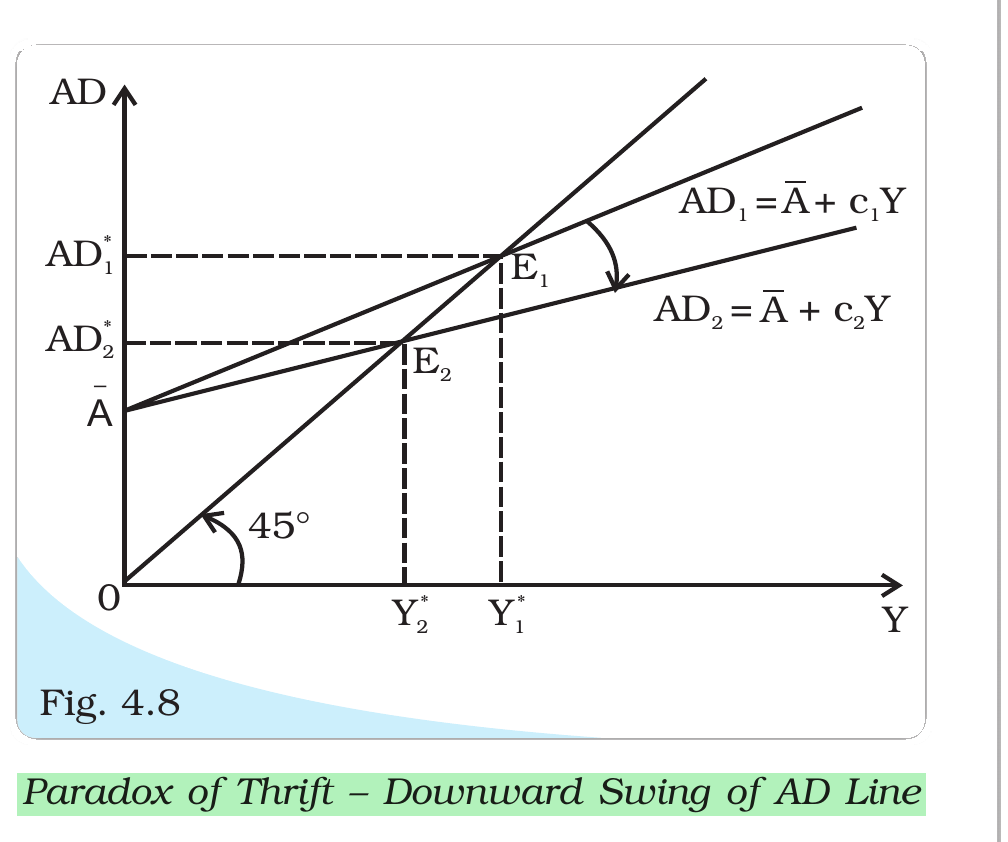
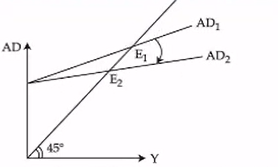
The figure shows the Paradox of Thrift. When all the people of an economy save a larger part of their income, the marginal propensity to consume falls. The AD line then becomes flatter and swings down from AD1 to AD2.
Equilibrium moves from E1 to E2, and output and income fall. Out of this lower income, people end up saving less than or the same as before. So trying to save more does not raise total savings, which is why it is called a paradox.
NCERT (2026-27): “Paradox of Thrift If all the people of the economy increase the proportion of income they save (i.e. if the mps of the economy increases) the total value of savings in the economy will not increase – it will either decline or remain unchanged. This result is known as the Paradox of Thrift – which states that as people become more thrifty they end up saving less or same as before. This result, though sounds apparently impossible, is actually a simple application of the model we have learnt.… …When A changes the line shifts upwards or downwards in parallel. When c changes, however, the line swings up or down. An increase in mps, or a decline in mpc, reduces the slope of the AD line and it swings downwards. We depict the situation in Fig. 4.8.…”
|