Study the following passage and answer the question.
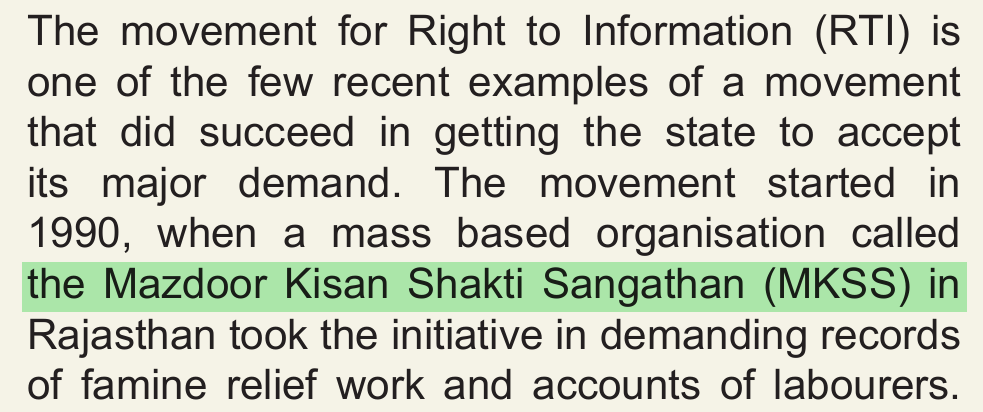
The movement for Right to Information (RTI) is one of the few recent examples of a movement that did succeed in getting the state to accept its major demand. The movement had a small success when they could force an amendment in the Rajasthan Panchayati Raj Act to permit the public to procure certified copies of documents held by the Panchayats. The Panchayats were also required to publish on a board and in newspapers the budget, accounts, expenditure, policies and beneficiaries. In 1996 MKSS formed National Council for People's Right to Information in Delhi to raise RTI to the status of a national campaign. Prior to that, the Consumer Education and Research Center, the Press Council and the Shourie committee had proposed a draft RTI law. In 2002, a weak Freedom of Information Act was legislated but never came into force. In 2004 RTI Bill was tabled and received presidential assent in June 2005.
Who formed a popular theatre 'Ghotala Rathyatra'?
Answer & explanation
Correct answer: option 2
The correct answer is Option (2) → Mazdoor Kisan Shakti Sangathan
‘Ghotala Rathyatra’ is a popular theatre form evolved by the Mazdoor Kisan Shakti Sangathan (MKSS) of Rajasthan, the organisation that started the movement for the Right to Information in 1990.
Note: The passage of this question is taken from the chapter ‘Rise of Popular Movements’, which was there in the pre-rationalised NCERT and has been deleted from subsequent editions of NCERT, including the NCERT book (2026-27).
NCERT (Pre-rationalised): Politics in India since Independence — Chapter 7: Rise of Popular Movements
|