
Read the following passage and answer the questions.
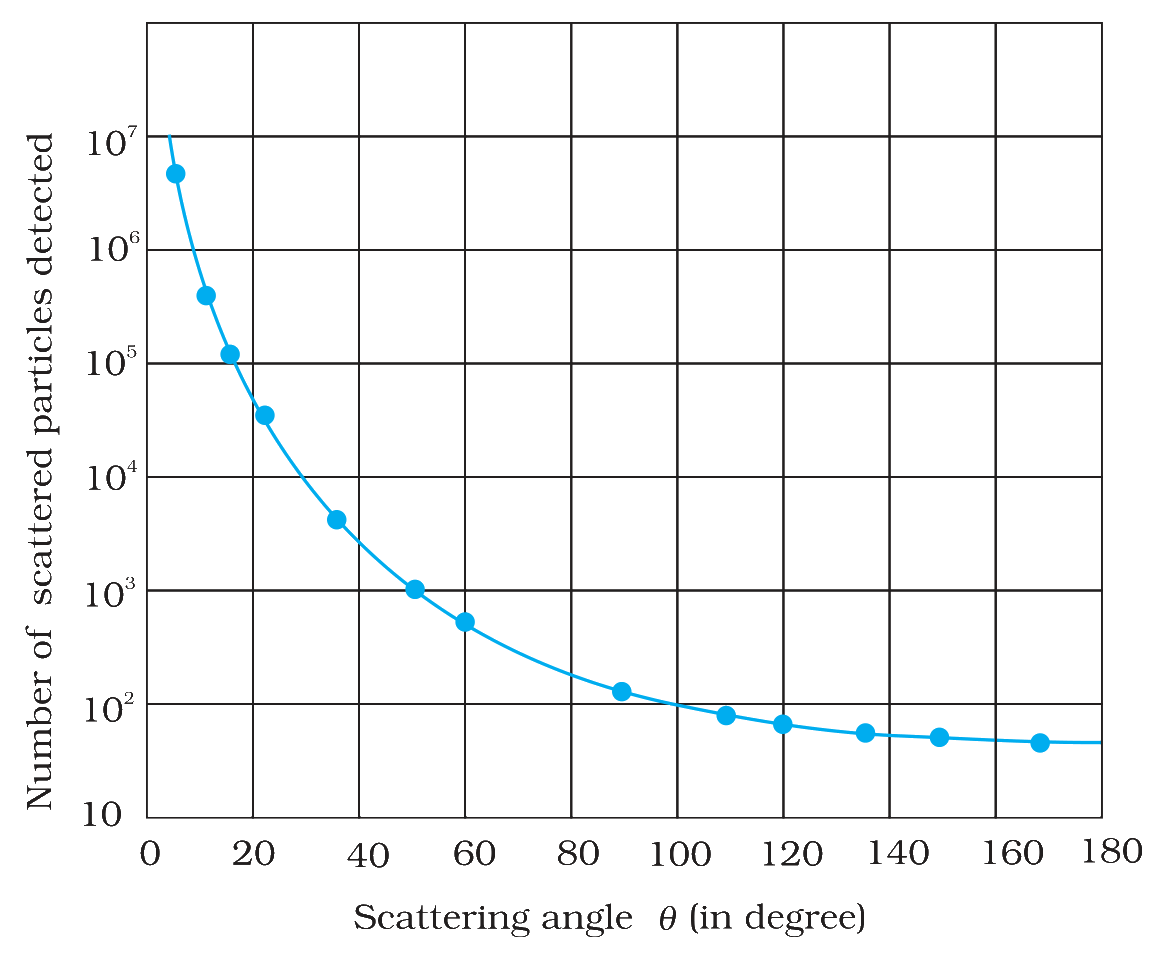
In 1911, H. Geiger and E. Marsden did a scattering experiment suggested by Rutherford. A radioactive source of \({}^{214}_{83}\mathrm{Bi}\) gave out alpha-particles of energy 5.5 MeV. The alpha-particles passed through lead bricks and then fell on a gold foil. The foil was only \(2.1\times10^{-7}\ \mathrm{m}\) thick. A detector made of a zinc sulphide screen and a microscope was placed near the foil. The detector could be turned around the foil. The whole apparatus was kept in a vacuum chamber. An alpha-particle carries a positive charge \(2e\). A gold nucleus carries a positive charge \(Ze\), with \(Z = 79\) for gold. The graph below shows the number of scattered alpha-particles detected at different scattering angles.
Match List-I with List-II.
| List-I (Part of the apparatus) | List-II (Its job) |
|---|---|
| (A) Lead bricks | (I) Gives a brief flash of light when an alpha-particle strikes it |
| (B) Very thin gold foil | (II) Turns the alpha-particles into a narrow beam |
| (C) Zinc sulphide screen | (III) Lets the number of scattered particles be found at different angles |
| (D) Rotatable detector | (IV) Makes sure that each alpha-particle is scattered not more than once |
Choose the correct answer from the options given below:
Answer & explanation
Correct answer: option 4
The correct answer is Option (4) → (A)-(II), (B)-(IV), (C)-(I), (D)-(III)
(A) Lead bricks — This matches (II). Only the alpha-particles moving along the opening get through the lead. So they reach the foil as a narrow beam.
(B) Very thin gold foil — This matches (IV). In a very thin foil, an alpha-particle meets at most one nucleus on its way through. So the path can be worked out for a single nucleus.
(C) Zinc sulphide screen — This matches (I). An alpha-particle striking the screen produces a brief flash of light, called a scintillation.
(D) Rotatable detector — This matches (III). The detector is turned to one angle after another, and the flashes are counted at each angle.
NCERT (2026-27):
Alpha-particle Scattering and Rutherford’s Nuclear Model of Atom – “Alpha-particles emitted by a 21483Bi radioactive source were collimated into a narrow beam by their passage through lead bricks. …”
Alpha-particle Scattering and Rutherford’s Nuclear Model of Atom – “As the gold foil is very thin, it can be assumed that α-particles will suffer not more than one scattering during their passage through it. …”
Alpha-particle Scattering and Rutherford’s Nuclear Model of Atom – “… The scattered alpha-particles on striking the screen produced brief light flashes or scintillations. …”
Alpha-particle Scattering and Rutherford’s Nuclear Model of Atom – “… The scattered alpha-particles were observed through a rotatable detector consisting of zinc sulphide screen and a microscope. … These flashes may be viewed through a microscope and the distribution of the number of scattered particles may be studied as a function of angle of scattering.”