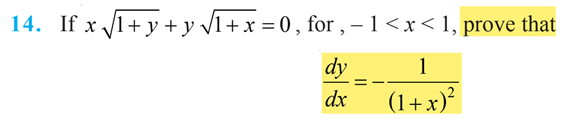
If \( x\sqrt{1+y}+y\sqrt{1+x}=0,x\gt -1 \) and \( x\ne y \) , then \( (1+x)^2\displaystyle\frac{dy}{dx} \) is equal to
Answer & explanation
Correct answer: option 1
The correct answer is Option (1) → −1
The condition \( x\ne y \) suggests finding y explicitly. Writing \( x\sqrt{1+y}=-y\sqrt{1+x} \) and squaring:
\( \displaystyle x^2(1+y)=y^2(1+x) \)
\( \displaystyle x^2-y^2+x^2y-xy^2=0 \)
\( \displaystyle (x-y)(x+y)+xy(x-y)=0 \)
\( \displaystyle (x-y)(x+y+xy)=0 \)
Since \( x\ne y \), \( x+y+xy=0 \):
\( \displaystyle y(1+x)=-x \)
\( \displaystyle y=-\frac{x}{1+x} \)
By the quotient rule:
\( \displaystyle \frac{dy}{dx}=-\frac{(1+x)\cdot 1-x\cdot 1}{(1+x)^2} \)
\( \displaystyle =-\frac{1}{(1+x)^2} \)
\( \displaystyle (1+x)^2\frac{dy}{dx}=-1 \)
NCERT (2026-27 edition):
Continuity and Differentiability