CUETMOCK
  • Pricing
  • Mentors
Log inStart freeStart free mocks→

First test, then trust

Try a free CUET mock test.

Join 5,00,000+ students who rehearsed exam day on the exact NTA screen before sitting CUET. On the web and on Android.

Start free mocks →Get the Android app
CUETMOCK

India's #1 CUET Mock Test Platform. Original NCERT-based questions on the exact NTA exam screen — trusted by 5,00,000+ students since CUET 2022.

Get it onGoogle PlayScan to download the CUETMOCK app

Mock tests

  • CUET mock test series
  • Browse all papers
  • Commerce mocks
  • Humanities (Arts) mocks
  • Science mocks
  • Languages & GAT mocks
  • Free practice questions
  • Pricing

Resources

  • CUET exam guide
  • CUET syllabus
  • Universities accepting CUET
  • Expert blogs
  • News & notifications
  • Webinars & counselling
  • CUET score calculator
  • How we estimate your rank
  • FAQs

Company

  • About us
  • Our leadership & team
  • Our toppers
  • Mentors
  • For schools
  • Contact us
  • Terms
  • Privacy
  • Refund policy

Talk to us

+91 7696 6630 56info@cuetmock.comWhatsApp us

Our other platforms

  • JEE Mock — For IIT-JEE aspirants
  • NEET Mock — For NEET aspirants

Newsletter

Exam updates, study material and offers — no spam.

© 2026 NYC Ventures Pvt. Ltd.

701-702, Royal Business Park, Zirakpur, Punjab - 140603

  • Terms of use
  • Privacy policy
  • Refund policy
  • Contact us

iCUETMOCK is an independent preparation platform, not affiliated with the National Testing Agency (NTA). Always check exam details on the official NTA website.

  • Home
  • Mock tests
  • CUET guide
  • Pricing
  • Log in
Home/Practice questions/Biology
BiologyOrganisms and Populations

What does 'r' in equation dN/dt = rN (K-N/K) represent?

What does 'r' in equation dN/dt = rN (K-N/K) represent?

Answer & explanation+

Correct answer: option 2

The correct answer is Option (2) → Intrinsic rate of natural increase

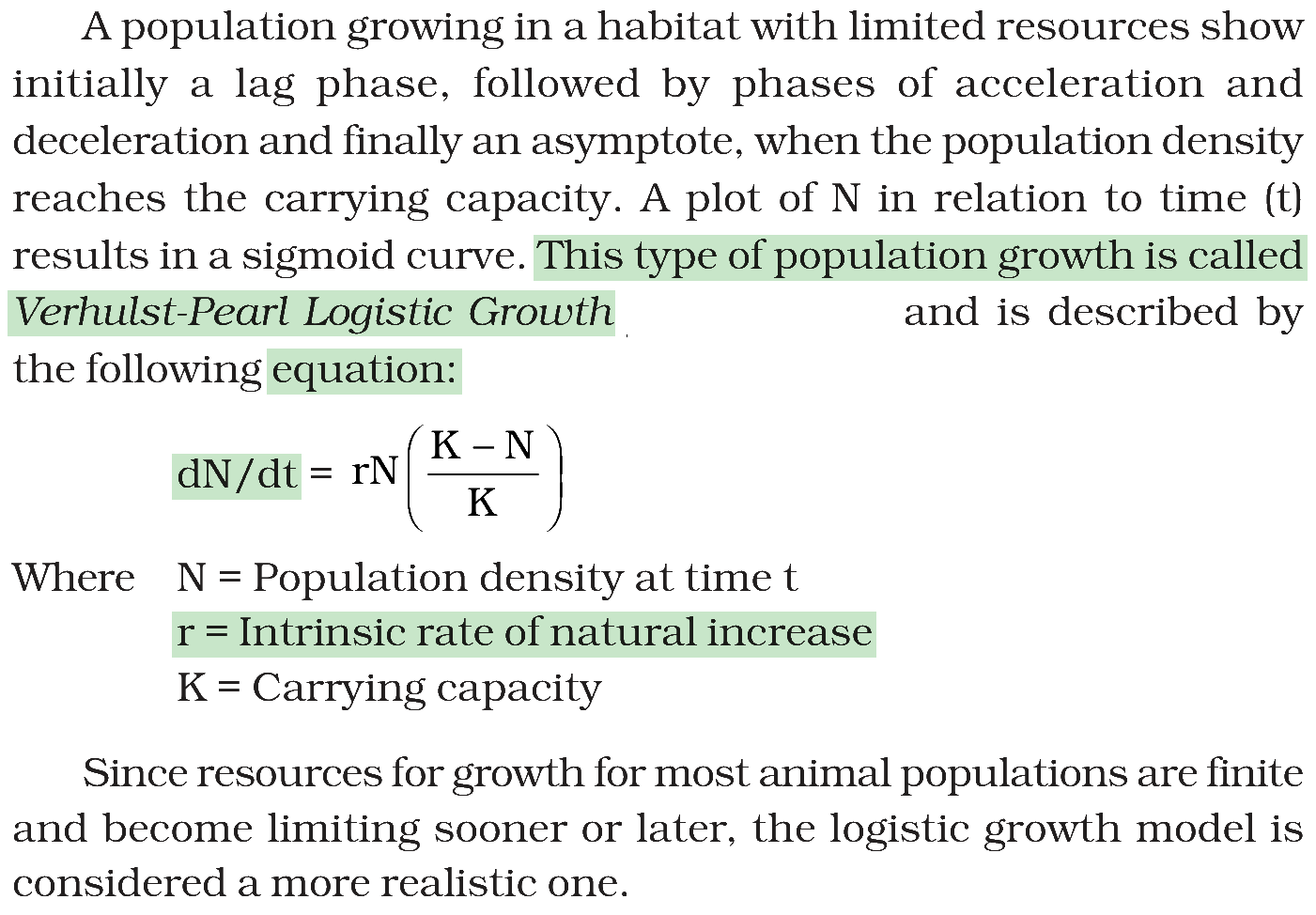
In the logistic growth equation, N is the population density at time t, K is the carrying capacity, and r is the intrinsic rate of natural increase: the rate at which the population would grow per individual when resources are not limiting.

Option (1) Extensive rate of natural increase — Incorrect. There is no such term.

Option (2) Intrinsic rate of natural increase — Correct. It is the built-in growth rate of the population, worked out from its birth and death rates.

Option (3) Extensive rate of natural decrease — Incorrect. There is no such term.

Option (4) Intrinsic rate of natural decrease — Incorrect. r measures increase, not decrease. A population falls only when deaths and emigration exceed births and immigration.

Note: A similar question was also asked in CUET (UG) 2025 on 20-05-2025 (Slot 1).

NCERT Extract:
Population Growth – …
Textbook extract

Textbook figure

Figure 11.3 Population growth curve a when responses are not limiting the growth, plot is exponential, b when responses are limiting the growth, plot is logistic, K is carrying capacity

Advertisement

Practise more on Organisms and Populations

Chapter-wise mocks on the real NTA exam screen, with solutions and your rank. Your first mocks are free.

Start free mocks →

Advertisement

Next questions

  1. Select the most appropriate ANTONYM of the given word. PLAUSIBLEEnglish · Antonyms
  2. Introduction of economic reforms in China took place in which year?Economics · Indian Economic Development: Comparative Development Experiences of India and its Neighbours
  3. The function y=f(x) has extreme values at the points where ____________Maths. Section A · Applications of Derivatives (Section A)
  4. Match List – I with List – II. List - I(Term) List - II(Meaning) (A) Brand Mark (I) The verbal component of a brand (B) Brand Name (II) A b…Business Studies · Marketing
  5. What is the relationship between a Partner and a Firm?Accountancy Part A · Accounting for Partnership
  6. What is the hybridisation of metal ion in [Ni(CO)_4] compound?Chemistry · Inorganic: Coordination Compounds
  7. 'पृथ्वी' शब्द का समानार्थी नहीं है-Hindi · Synonyms
  8. Why do the IAEA teams regularly inspect nuclear facilities all over the world?Political Science · Contemporary World Politics: International Organisations
  9. Two chords AB and CD of lengths 4 cm and 10 cm respectively are parallel and are on the same side of the centre O of a circle. If the dista…General Aptitude Test · Quantitative Reasoning
  10. Which region was known as the ‘nursery of the Bengal Army’ from 1840s onwards ?History · Modern India: Rebels and the Raj