CUETMOCK
  • Pricing
  • Mentors
Log inStart freeStart free mocks→

First test, then trust

Try a free CUET mock test.

Join 5,00,000+ students who rehearsed exam day on the exact NTA screen before sitting CUET. On the web and on Android.

Start free mocks →Get the Android app
CUETMOCK

India's #1 CUET Mock Test Platform. Original NCERT-based questions on the exact NTA exam screen — trusted by 5,00,000+ students since CUET 2022.

Get it onGoogle PlayScan to download the CUETMOCK app

Mock tests

  • CUET mock test series
  • Browse all papers
  • Commerce mocks
  • Humanities (Arts) mocks
  • Science mocks
  • Languages & GAT mocks
  • Free practice questions
  • Pricing

Resources

  • CUET exam guide
  • CUET syllabus
  • Universities accepting CUET
  • Expert blogs
  • News & notifications
  • Webinars & counselling
  • CUET score calculator
  • How we estimate your rank
  • FAQs

Company

  • About us
  • Our leadership & team
  • Our toppers
  • Mentors
  • For schools
  • Contact us
  • Terms
  • Privacy
  • Refund policy

Talk to us

+91 7696 6630 56info@cuetmock.comWhatsApp us

Our other platforms

  • JEE Mock — For IIT-JEE aspirants
  • NEET Mock — For NEET aspirants

Newsletter

Exam updates, study material and offers — no spam.

© 2026 NYC Ventures Pvt. Ltd.

701-702, Royal Business Park, Zirakpur, Punjab - 140603

  • Terms of use
  • Privacy policy
  • Refund policy
  • Contact us

iCUETMOCK is an independent preparation platform, not affiliated with the National Testing Agency (NTA). Always check exam details on the official NTA website.

  • Home
  • Mock tests
  • CUET guide
  • Pricing
  • Log in
Home/Practice questions/History
HistoryAncient India: Bricks, Beads and Bones

Match List I with List II:List IList II(A)Harappan Civilisation(I)100…

Match List I with List II:

List IList II
(A)Harappan Civilisation(I)1000 BCE
(B)Megalithic Burials(II)2600 BCE
(C)Lower Palaeolithic(III)600 BCE
(D)Early Historic(IV)2 million BP

Choose the correct answer from the options given below:

Answer & explanation+

Correct answer: option 3

The correct answer is Option (3) → A-II, B-I, C-IV, D-III

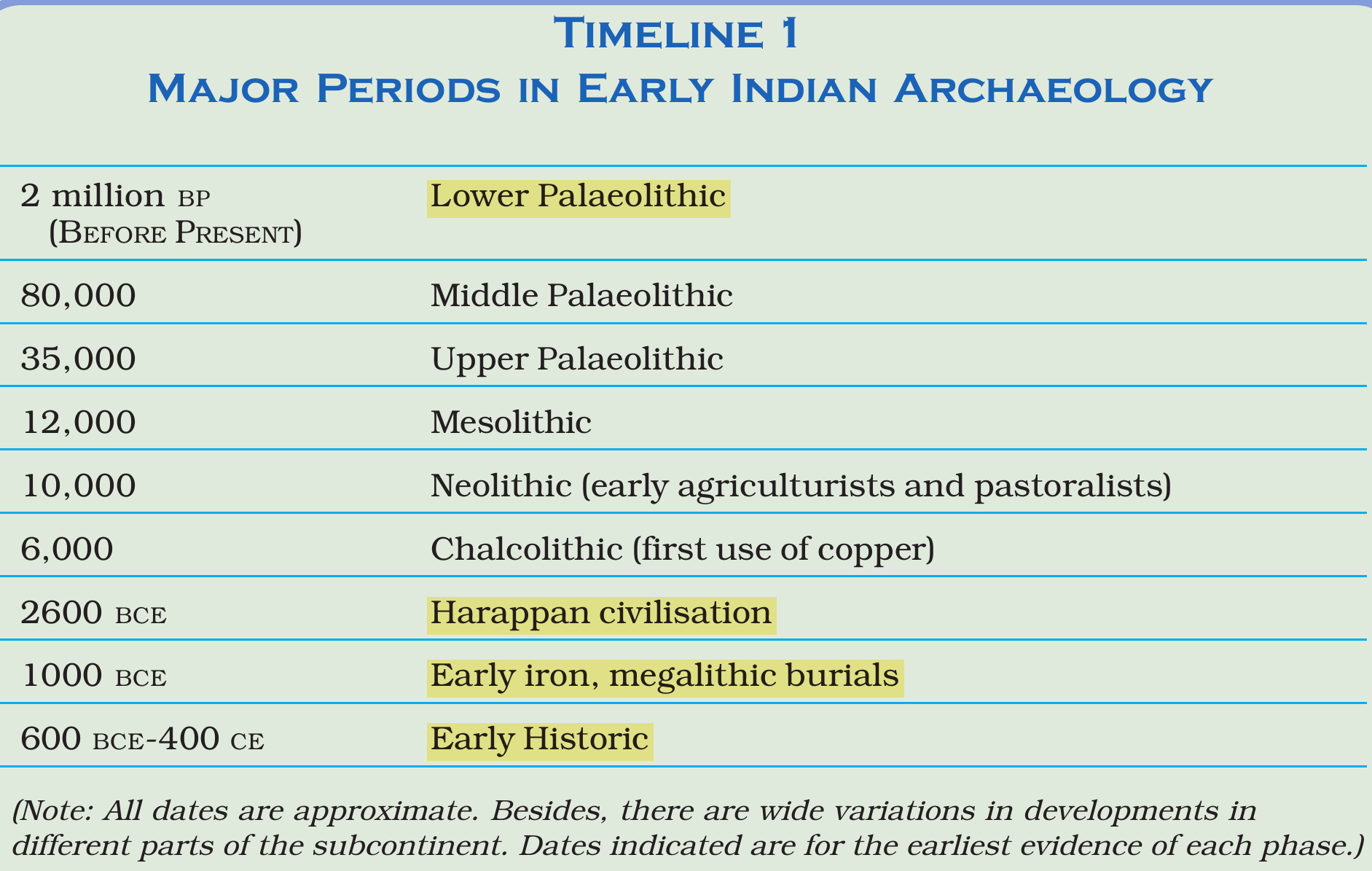
(A) Harappan Civilisation — this matches (II) 2600 BCE. The timeline of major periods in early Indian archaeology places the Harappan civilisation at 2600 BCE.

(B) Megalithic Burials — this matches (I) 1000 BCE. The phase of early iron and megalithic burials begins about 1000 BCE.

(C) Lower Palaeolithic — this matches (IV) 2 million BP. The Lower Palaeolithic is the earliest phase, about 2 million years before the present (BP).

(D) Early Historic — this matches (III) 600 BCE. The Early Historic period runs from about 600 BCE to 400 CE.

Note: A same/similar question was asked in CUET (UG) in the papers below.

20262025202420232022
–02-06 S1*–14-06 S2–

* A similar question.


NCERT: Themes in Indian History Part I — Chapter 1: Bricks, Beads and Bones (2026-27)

NCERT extract

Advertisement

Practise more on Ancient India: Bricks, Beads and Bones

Chapter-wise mocks on the real NTA exam screen, with solutions and your rank. Your first mocks are free.

Start free mocks →

Advertisement

Next questions

  1. The lines left out of the passage describe a new mode of disposal of the dead that emerged in central and south India from the first millen…History · Ancient India: Kings, Farmers and Towns
  2. The government directly affects the level of equilibrium income in two specific ways. Which of the following describes them?Economics · Macro Economics: Government Budget and Economy
  3. Select the most appropriate collocation to fill in the blank. We came to ________ as we were passing through.English · Fill Blanks
  4. In Young's double slit experiment, separation between the slits is 2 × 10^–3 m and distance of the screen from the slit is 2.5 m. Light in…Physics · Wave Optics
  5. By selling 33 articles, a person gets the profit equal to selling price of 8 articles. Find profit percentGeneral Aptitude Test · Numerical Ability
  6. Complete the sentences given in List-I with the appropriate words given in List-IILIST-I(Sentences)LIST-II(Words)A. Justify your charges---…English · Grammar: Conjunction
  7. What does 'r' in equation dN/dt = rN (K-N/K) represent?Biology · Organisms and Populations
  8. Select the most appropriate ANTONYM of the given word. PLAUSIBLEEnglish · Antonyms
  9. Introduction of economic reforms in China took place in which year?Economics · Indian Economic Development: Comparative Development Experiences of India and its Neighbours
  10. The function y=f(x) has extreme values at the points where ____________Maths. Section A · Applications of Derivatives (Section A)