Cyclohexene is best prepared from cyclohexanol by which of the following reagents?
Answer & explanation
Correct answer: option 1
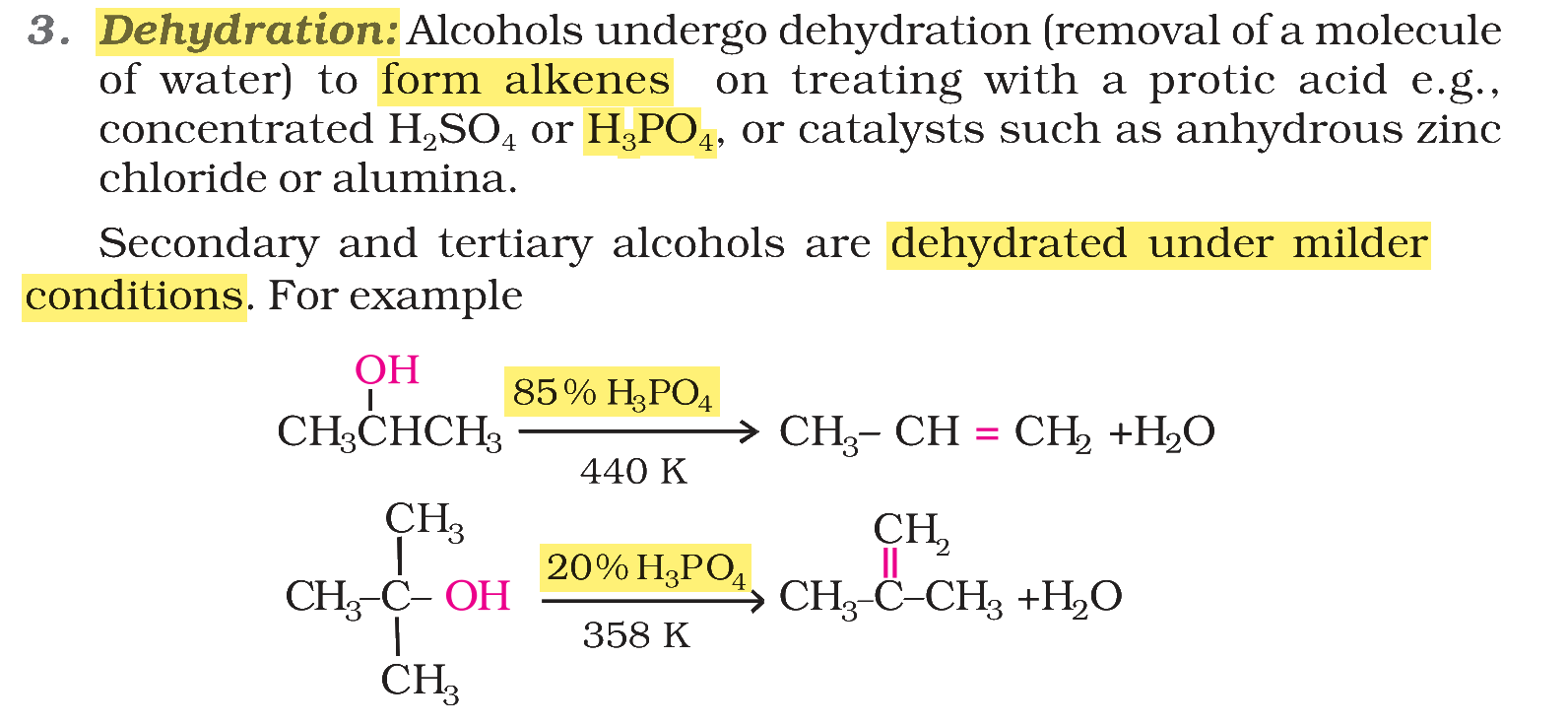
The correct answer is Option (1) → conc. H3PO4
Dehydration of an alcohol needs a protic acid whose anion is a very weak nucleophile, so that the carbocation loses a proton instead of picking up the anion. Concentrated \( \ce{H3PO4} \) is such an acid. Cyclohexanol, a secondary alcohol, gives cyclohexene:
\( \displaystyle \ce{C6H11OH} \xrightarrow[\text{heat}]{\text{conc. }\ce{H3PO4}} \ce{C6H10 + H2O} \)
Why the other options are incorrect
Option (2) conc. HCl / ZnCl2 — Incorrect. This is the Lucas reagent; \( \ce{Cl^-} \) replaces the \( \ce{-OH} \) group and chlorocyclohexane is formed:
\( \displaystyle \ce{C6H11OH + HCl} \xrightarrow{\ce{ZnCl2}} \ce{C6H11Cl + H2O} \)
Option (3) conc. HCl — Incorrect. It gives the substitution product chlorocyclohexane, slowly:
\( \displaystyle \ce{C6H11OH + HCl -> C6H11Cl + H2O} \)
Option (4) conc. HBr — Incorrect. \( \ce{Br^-} \) is a good nucleophile, so bromocyclohexane is formed:
\( \displaystyle \ce{C6H11OH + HBr -> C6H11Br + H2O} \)
NCERT (2026-27 edition):
Chemical Reactions