
Match List - I with List - II.
| List - I | List - II |
| (A) Clemmensen reduction | (I) 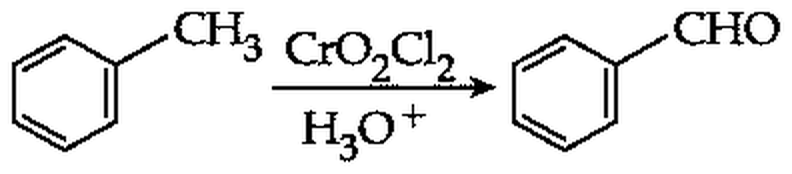 |
| (B) Kolbe’s reaction | (II) \( \mathrm{\gt C{=}O}\xrightarrow[\text{KOH, ethylene glycol, heat}]{\mathrm{NH_2NH_2}}\mathrm{\gt CH_2} \) |
| (C) Etard reaction | (III) \( \mathrm{\gt C{=}O+HCl}\xrightarrow{\text{Zn-Hg}}\mathrm{\gt CH_2} \) |
| (D) Wolff-Kishner reduction | (IV) 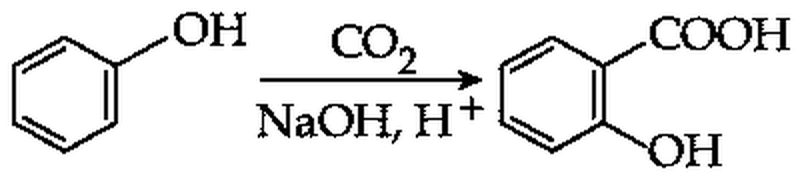 |
Choose the correct answer from the options given below :
Answer & explanation
Correct answer: option 4
The correct answer is Option (4) → (A)-(III), (B)-(IV), (C)-(I), (D)-(II)
These named reactions are told apart by the starting material and the reagent:
Reduction of C=O to CH2: Clemmensen uses zinc amalgam and concentrated HCl (acidic medium); Wolff-Kishner uses hydrazine, then KOH (or NaOH) in a high-boiling solvent such as ethylene glycol (basic medium).
Etard reaction: chromyl chloride oxidises the methyl group of toluene to a chromium complex, which on hydrolysis gives benzaldehyde.
Kolbe’s reaction: sodium phenoxide reacts with \( \ce{CO2} \), a weak electrophile, and acidification gives salicylic acid (o-hydroxybenzoic acid).
(A) Clemmensen reduction — This matches (III). Zinc amalgam and concentrated HCl reduce the carbonyl group to \( \ce{CH2} \):
\( \displaystyle \ce{>C=O} \xrightarrow{\ce{Zn-Hg},\ \text{conc. }\ce{HCl}} \ce{>CH2 + H2O} \)
(B) Kolbe’s reaction — This matches (IV). Phenol is converted to sodium phenoxide, which is attacked by \( \ce{CO2} \) at the ortho position; acid then gives salicylic acid:
\( \displaystyle \ce{C6H5OH} \xrightarrow{\ce{NaOH}} \ce{C6H5ONa} \xrightarrow[\text{(ii) }\ce{H^+}]{\text{(i) }\ce{CO2}} \text{o-}\ce{HOC6H4COOH} \)
(C) Etard reaction — This matches (I). Chromyl chloride converts toluene to benzaldehyde through a chromium complex that is hydrolysed:
\( \displaystyle \ce{C6H5CH3} \xrightarrow[\text{(ii) }\ce{H3O^+}]{\text{(i) }\ce{CrO2Cl2},\ \ce{CS2}} \ce{C6H5CHO} \)
(D) Wolff-Kishner reduction — This matches (II). The carbonyl compound forms a hydrazone with \( \ce{NH2NH2} \); heating the hydrazone with KOH in ethylene glycol releases \( \ce{N2} \) and leaves \( \ce{CH2} \):
\( \displaystyle \ce{>C=O} \xrightarrow[-\ce{H2O}]{\ce{NH2NH2}} \ce{>C=NNH2} \xrightarrow[\text{ethylene glycol, heat}]{\ce{KOH}} \ce{>CH2 + N2} \)
Shortcut: The pair (C)–(I) appears only in Option (4).
NCERT (2026-27 edition):
Reduction to Hydrocarbons – “The carbonyl group of aldehydes and ketones is reduced to CH2 group on treatment with zinc-amalgam and concentrated hydrochloric acid [Clemmensen reduction] or with hydrazine followed by heating with sodium or potassium hydroxide in high boiling solvent such as ethylene glycol (Wolff-Kishner reduction).”
Use of Chromyl Chloride (CrO2Cl2) – “Chromyl chloride oxidises methyl group to a chromium complex, which on hydrolysis gives corresponding benzaldehyde.
\( \ce{C6H5CH3} \xrightarrow[\text{(ii) }\ce{H3O^+}]{\text{(i) }\ce{CrO2Cl2},\ \ce{CS2}} \ce{C6H5CHO} \)
This reaction is called Etard reaction.”
Kolbe’s Reaction – “Phenoxide ion generated by treating phenol with sodium hydroxide is even more reactive than phenol towards electrophilic aromatic substitution. Hence, it undergoes electrophilic substitution with carbon dioxide, a weak electrophile. Ortho hydroxybenzoic acid is formed as the main reaction product.”