Which of the following statement is incorrect in regards to variation of rate of reaction with respect to temperature?
Answer & explanation
Correct answer: option 2
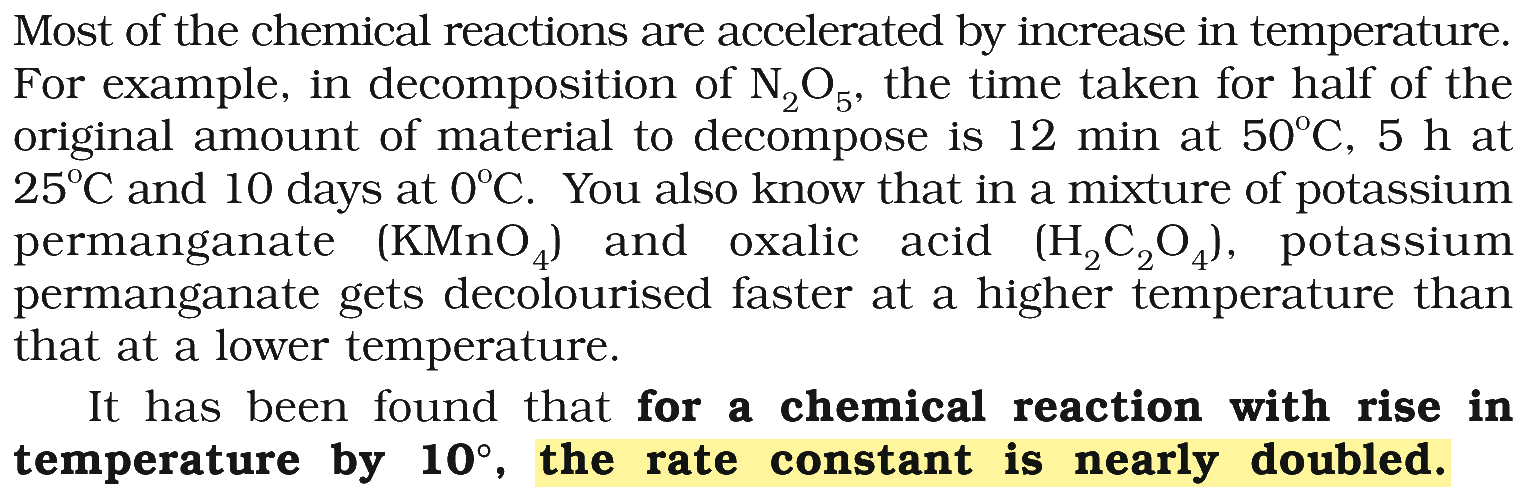
The correct answer is Option (2) → On increasing the temperature, the rate constant decreases exponentially.
For most chemical reactions, both the rate and the rate constant increase as the temperature rises. The Arrhenius equation shows why:
\( \displaystyle k=A\,e^{-E_a/RT} \)
As \( T \) increases, \( -E_a/RT \) becomes less negative, so the exponential term, and with it \( k \), increases. At a higher temperature a larger fraction of molecules have energy equal to or greater than the activation energy, so more collisions are effective and the reaction goes faster. Lowering the temperature has the opposite effect.
Option (1) On increasing the temperature, the rate of reaction increases. — Agrees with the effect of temperature. A larger \( k \) at the same concentrations gives a faster rate.
Option (2) On increasing the temperature, the rate constant decreases exponentially. — Does not agree with the effect of temperature. The rate constant increases exponentially with temperature (Arrhenius equation); it never falls as the temperature rises.
Option (3) On increasing the temperature, the number of effective collisions increases. — Agrees with the effect of temperature. More molecules reach the activation energy, so more of the collisions lead to reaction.
Option (4) On decreasing the temperature, the rate of reaction decreases. — Agrees with the effect of temperature. Fewer molecules reach the activation energy, so the reaction slows down.
NCERT (2026-27 edition):
Temperature Dependence of the Rate of a Reaction