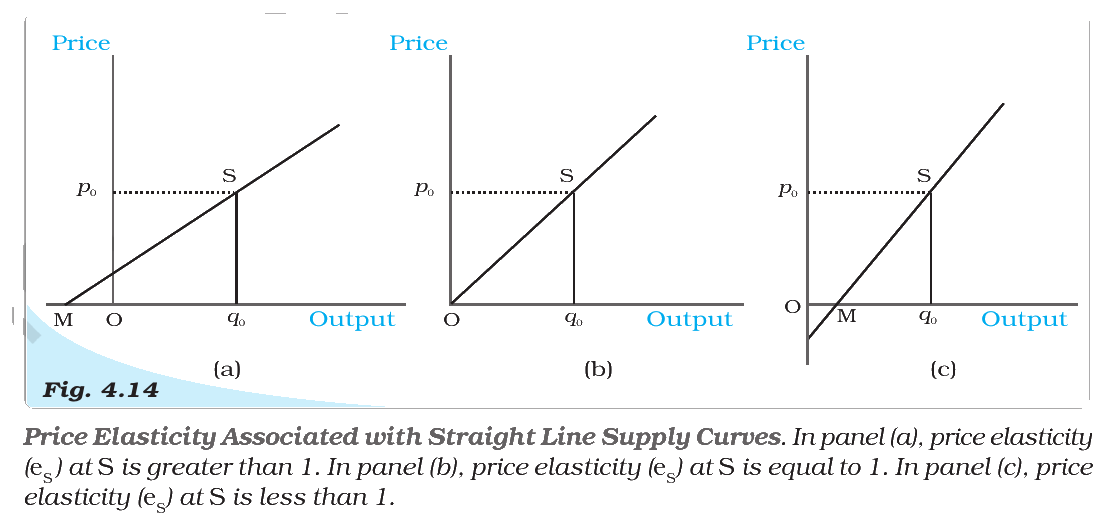
Arrange the following supply curves in increasing order of their price elasticity of supply at any point on them:
(A) A straight-line supply curve that passes through the origin
(B) A vertical supply curve
(C) A straight-line supply curve that cuts the price axis at a positive price
(D) A straight-line supply curve that cuts the quantity axis at a positive quantity
Choose the correct answer from the options given below:
Answer & explanation
Correct answer: option 2
The correct answer is Option (2) → (B), (D), (A), (C)
For a straight-line supply curve, eS at S = Mq0/Oq0, where M is where the line meets the quantity axis.
(B) A vertical supply curve — supply does not respond to price at all, so eS = 0.
(D) A straight-line supply curve that cuts the quantity axis at a positive quantity — Mq0 < Oq0, so eS is less than 1.
(A) A straight-line supply curve that passes through the origin — M is at O, so eS = 1.
(C) A straight-line supply curve that cuts the price axis at a positive price — M lies on the negative side, Mq0 > Oq0, so eS is greater than 1.
NCERT (2026-27): “4.7 Price Elasticity of Supply … When the supply curve is vertical, supply is completely insensitive to price and the elasticity of supply is zero. …” “The Geometric Method Consider the Figure 4.14. Panel (a) shows a straight line supply curve. S is a point on the supply curve. It cuts the price-axis at its positive range and as we extend the straight line, it cuts the quantity-axis at M which is at its negative range. The price elasticity of this supply curve at the point S is given by the ratio, Mq0/Oq0. For any point S on such a supply curve, we see that Mq0 > Oq0. The elasticity at any point on such a supply curve, therefore, will be greater than 1.” “The Geometric Method … In panel (c) we consider a straight line supply curve and S is a point on it. It cuts the quantity-axis at M which is at its positive range. Again the price elasticity of this supply curve at the point S is given by the ratio, Mq0/Oq0. Now, Mq0 < Oq0 and hence, eS < 1. S can be any point on the supply curve, and therefore at all points on such a supply curve eS < 1.” “The Geometric Method … Now we come to panel (b). Here the supply curve goes through the origin. One can imagine that the point M has coincided with the origin here, i.e., Mq0 has become equal to Oq0. The price elasticity of this supply curve at the point S is given by the ratio, Oq0/Oq0 which is equal to 1. At any point on a straight line, supply curve going through the origin price elasticity will be one.”
|