
Consider the following statements.
I. Genetic engineering includes techniques to alter the chemistry of genetic material (DNA and RNA) and to introduce it into host organisms.
II. The E. coli cloning vector pBR322 carries the antibiotic resistance genes ampR and tetR.
III. Restriction enzymes belong to a larger class of enzymes called nucleases.
Which of the statements given above are correct?
Answer & explanation
Correct answer: option 4
The correct answer is Option (4) → I, II and III
True. I. Genetic engineering includes techniques to alter the chemistry of genetic material (DNA and RNA) and to introduce it into host organisms. It is one of the two core techniques of modern biotechnology. The changed DNA put into a host changes the host’s phenotype.
True. II. The E. coli cloning vector pBR322 carries the antibiotic resistance genes ampR and tetR. These genes give resistance to ampicillin and tetracycline. They act as selectable markers, and foreign DNA can be put into the tetracycline gene (Figure 9.4).
True. III. Restriction enzymes belong to a larger class of enzymes called nucleases. Nucleases are of two kinds. Exonucleases remove nucleotides from the ends of DNA. Endonucleases, such as restriction enzymes, cut at specific positions inside the DNA.
All three statements are correct.
NCERT Extract:
Principles of Biotechnology – “… (i) Genetic engineering : Techniques to alter the chemistry of genetic material (DNA and RNA), to introduce these into host organisms and thus change the phenotype of the host organism.”
Cloning Vectors – “… The ligation of alien DNA is carried out at a restriction site present in one of the two antibiotic resistance genes. For example, you can ligate a foreign DNA at the BamH I site of tetracycline resistance gene in the vector pBR322.”
Restriction Enzymes – “… Restriction enzymes belong to a larger class of enzymes called nucleases. These are of two kinds; exonucleases and endonucleases. Exonucleases remove nucleotides from the ends of the DNA whereas, endonucleases make cuts at specific positions within the DNA.”
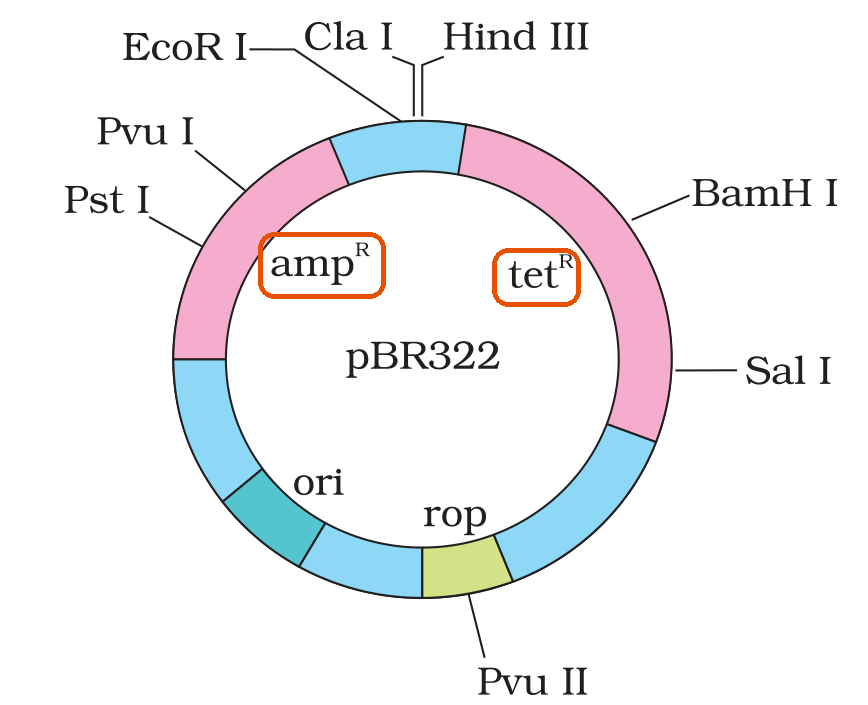
Figure 9.4 E. coli cloning vector pBR322 showing restriction sites (Hind III, EcoR I, BamH I, Sal I, Pvu II, Pst I, Cla I), ori and antibiotic resistance genes (ampR and tetR). rop codes for the proteins involved in the replication of the plasmid.