
Primary Alkyl halide $C_4H_9Br$ (X) reacts with alcoholic KOH to give the compound (Y). Compound (Y) is reacted with HBr to give (Z) which is an isomer of (X). When (X) is reacted with Na/dry ether, it gives a compound (T), $C_8H_{18}$, which is different from the compound formed when n-butyl bromide is reacted with Na/dry ether. The correct IUPAC name of (T) is:
Answer & explanation
Correct answer: option 2
The correct answer is Option (2) → 2,5-Dimethylhexane
The molecular formula $C_4H_9Br$ can correspond to four structural isomers:
- 1-Bromobutane (n-butyl bromide)
- 2-Bromobutane (sec-butyl bromide)
- 1-Bromo-2-methylpropane (isobutyl bromide)
- 2-Bromo-2-methylpropane (tert-butyl bromide)
The question states that X is a primary alkyl halide, therefore possible structures are:
- 1-Bromobutane
- 1-Bromo-2-methylpropane (isobutyl bromide)
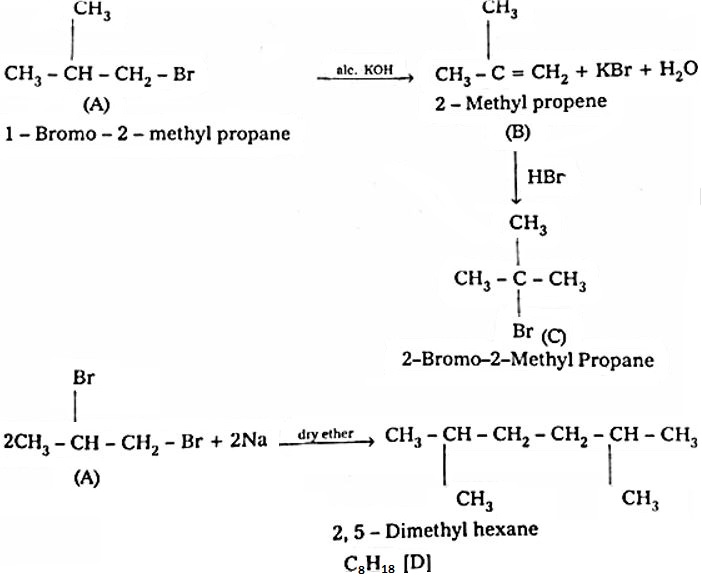
When X reacts with alcoholic KOH, elimination occurs forming an alkene (Y).
If X = isobutyl bromide (1-bromo-2-methylpropane), elimination produces:
2-methylpropene
When 2-methylpropene reacts with HBr, Markovnikov addition occurs to give:
tert-butyl bromide
This compound is an isomer of the original $C_4H_9Br$, satisfying the condition in the question.
Thus,
$\mathbf{X = \text{isobutyl bromide (1-bromo-2-methylpropane)}}$
X = isobutyl bromide
Now consider the Wurtz reaction.
In presence of Na / dry ether, two molecules of alkyl halide couple:
$2 R-Br + 2 Na \rightarrow R-R + 2 NaBr$
For isobutyl bromide:
$(CH_3)_2CH-CH_2-Br$
Coupling gives:
$(CH_3)_2CH-CH_2-CH_2-CH(CH_3)_2$
The longest carbon chain contains six carbon atoms, and there are two methyl groups at positions 2 and 5.
Therefore the IUPAC name of compound T is:
2,5-Dimethylhexane
Option A: 2,3-Dimethyloctane
This compound contains 10 carbon atoms, while the Wurtz reaction product should have 8 carbon atoms ($C_{8}H_{18}$). Therefore this option is incorrect.
Option B: 2,5-Dimethylhexane
This structure is formed by coupling of two isobutyl groups in the Wurtz reaction. The longest chain has 6 carbons, with methyl substituents at C-2 and C-5. Hence this option is correct.
Option C: 2,3-Diethylbutane
Although it contains 8 carbons, this structure does not correspond to the coupling product of isobutyl bromide. Therefore this option is incorrect.
Option D: 2-Isobutybutane
This name does not follow proper IUPAC rules because the longest carbon chain is not correctly selected.