
Read the passage carefully and answer the questions.
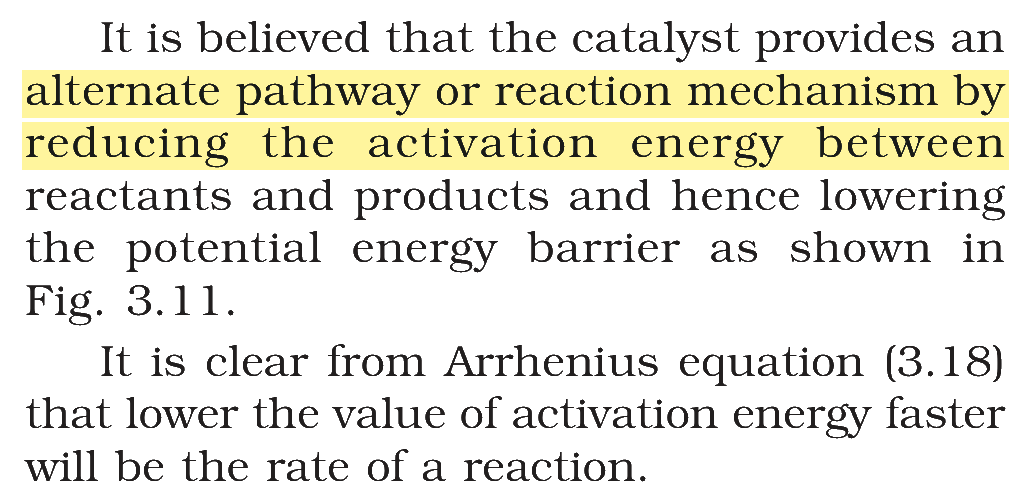
The speed at which a chemical reaction takes place is called the rate of reaction. The rate of reaction depends on various factors like concentration of the reactants, temperature, etc. The relation between the rate of reaction and the concentration of reacting species is represented by the equation \( r = k[A]^x[B]^y \), where \( x \) and \( y \) are the order of the reaction with respect to the reactants A and B, respectively. The overall order of the reaction is \( x + y \). The rate of reaction can also be increased by the use of a catalyst which provides an alternate pathway of lower activation energy. It increases the rate of forward and backward reaction to an equal extent. It does not alter the Gibbs energy of the reaction.
The role of a catalyst is to change
Answer & explanation
Correct answer: option 3
The correct answer is Option (3) → Activation energy of a reaction.
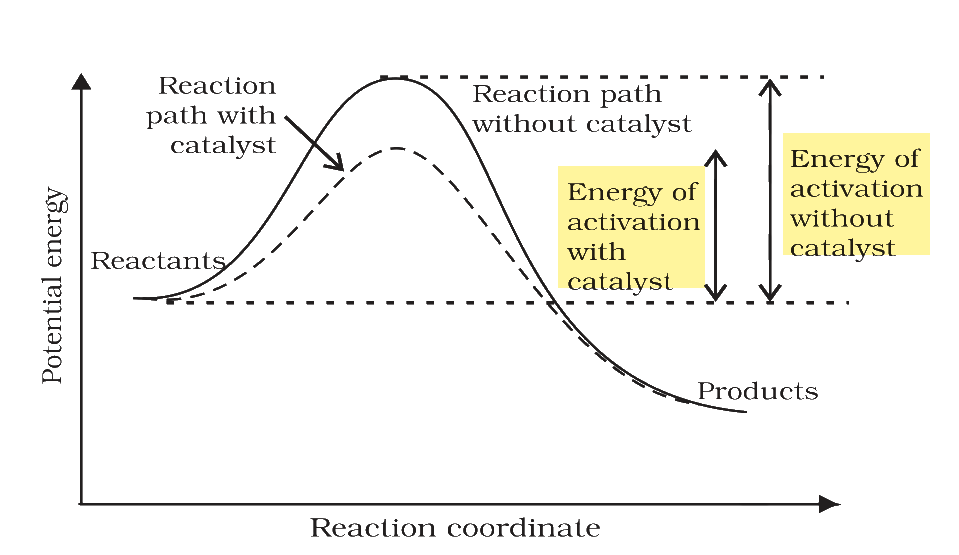
A catalyst takes part in the reaction through temporary bonds with the reactants and is given back unchanged at the end. It provides an alternative pathway of lower activation energy, so a larger fraction of molecules can cross the energy barrier and the reaction becomes faster.
The catalyst lowers the barrier for the forward and the backward reaction equally. It does not change the energies of the reactants and products, so the enthalpy, the Gibbs energy and the equilibrium constant of the reaction stay the same; equilibrium is only reached sooner.
Why the other options are incorrect
Option (1) Gibbs energy of the reaction. — Incorrect. \( \Delta G \) depends only on the initial and final states, which the catalyst does not change; a catalyst cannot make a non-spontaneous reaction spontaneous.
Option (2) Enthalpy of a reaction. — Incorrect. The reactants and products have the same energies with or without the catalyst, so \( \Delta H \) is unchanged.
Option (4) Equilibrium constant. — Incorrect. Both forward and backward rates rise by the same factor, so their ratio, the equilibrium constant, is unchanged.
NCERT (2026-27 edition):
Effect of Catalyst – …
Note: The same/similar question has been asked in different years by NTA as per the details given below:
| 2026 | 2025 | 2024 | 2023 | 2022 |
|---|---|---|---|---|
| – | 13-05 S1 | – | 13-06 S3 | – |