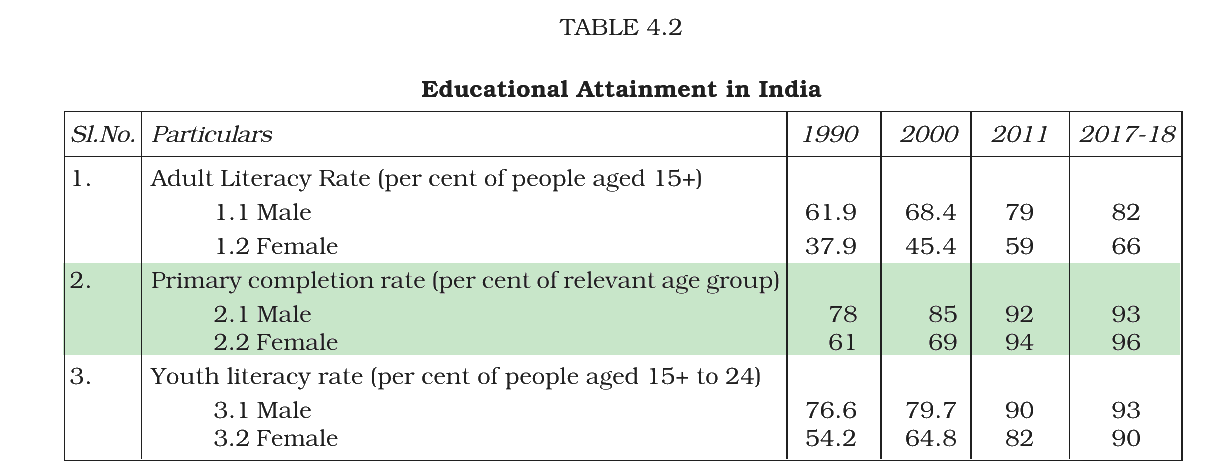
The table gives the primary completion rate (per cent of relevant age group) in India.
| Year | Male | Female |
|---|---|---|
| 1990 | 78 | 61 |
| 2000 | 85 | 69 |
| 2011 | 92 | 94 |
| 2017-18 | 93 | 96 |
Which of the following statements is correct?
Answer & explanation
Correct answer: option 2
The correct answer is Option (2) → The female rate rose above the male rate by 2011 and stayed above it in 2017-18.
Read the two columns year by year. In 2011 the female rate (94) is above the male rate (92), and in 2017-18 it is still above (96 against 93).
Option (1) The female rate was below the male rate in every year shown. — Incorrect. It was below only in 1990 and 2000.
Option (2) The female rate rose above the male rate by 2011 and stayed above it in 2017-18. — Correct. Female 94 and 96 against male 92 and 93.
Option (3) The male rate fell between 2011 and 2017-18. — Incorrect. It rose from 92 to 93.
Option (4) The gap between the male and female rates was the same in 1990 and 2000. — Incorrect. The gap was 17 points in 1990 (78 - 61) and 16 in 2000 (85 - 69).
NCERT (2026-27): “Educational Achievements in India: Generally, educational achievements in a country are indicated in terms of adult literacy level, primary education completion rate and youth literacy rate. These statistics for the last two decades are given above in Table 4.2.”
|