
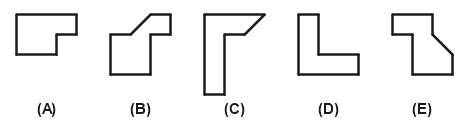
Pick the set of parts from (A), (B), (C), (D) and (E) that join together to form a complete square. A part may be turned round but its size cannot change.
Answer & explanation
Correct answer: option 2
The correct answer is Option (2) → (B), (C) and (D) only
Parts form a complete square only if, placed side by side, they fill the square exactly, with no gap and no overlap. (B), (C) and (D) fill a 4 × 4 square when (B) is turned through 180°, (C) is turned through 180° and (D) is turned through 90° clockwise.
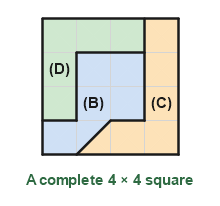
Option (1) — Incorrect. (A) has as many small squares as (D) but one of them is in a different place. (A), (B) and (C) cover as many small squares as the 4 × 4 square, but they cannot be fitted into it, or into any complete square, without a gap or an overlap.
Option (3) — Incorrect. (A) has as many small squares as (D) but one of them is in a different place. Together (A), (B) and (D) cover 15½ small squares, while the 4 × 4 square has 16, so they cannot make it; they cannot be fitted into any other complete square either.
Option (4) — Incorrect. (E) has as many small squares as (B) but one of them is in a different place. (B), (D) and (E) cover as many small squares as the 4 × 4 square, but they cannot be fitted into it, or into any complete square, without a gap or an overlap.