
Statement I: In PCR, repeated amplification is achieved by the use of a thermostable DNA polymerase isolated from Escherichia coli.
Statement II: In PCR, each cycle has three steps: denaturation, primer annealing and extension of primers.
In the light of the above statements, choose the correct answer from the options given below:
Answer & explanation
Correct answer: option 4
The correct answer is Option (4) → Statement I is incorrect but Statement II is correct.
PCR (Polymerase Chain Reaction) makes many copies of a chosen piece of DNA in vitro. It uses two primers, the DNA template, nucleotides and a DNA polymerase. Heat is used again and again to separate the DNA strands, so the polymerase must stay active at high temperature.
Statement I: In PCR, repeated amplification is achieved by the use of a thermostable DNA polymerase isolated from Escherichia coli. — False. The thermostable DNA polymerase comes from the bacterium Thermus aquaticus, and is called Taq polymerase. It stays active during the high temperature used to denature the DNA.
Statement II: In PCR, each cycle has three steps: denaturation, primer annealing and extension of primers. — True. Heat first separates the two strands (denaturation). The primers then bind to their matching regions (annealing), and the polymerase extends the primers (extension). Repeating these cycles many times amplifies the DNA about a billion times.
Note: Statement II is built from the title under Figure 9.6. Figure titles sit quietly below the pictures, but examiners know where they live, so read every nook and corner of NCERT, titles included.
NCERT Extract:
Amplification of Gene of Interest using PCR – “… If the process of replication of DNA is repeated many times, the segment of DNA can be amplified to approximately billion times, i.e., 1 billion copies are made. Such repeated amplification is achieved by the use of a thermostable DNA polymerase (isolated from a bacterium, Thermus aquaticus), which remain active during the high temperature induced denaturation of double stranded DNA.”
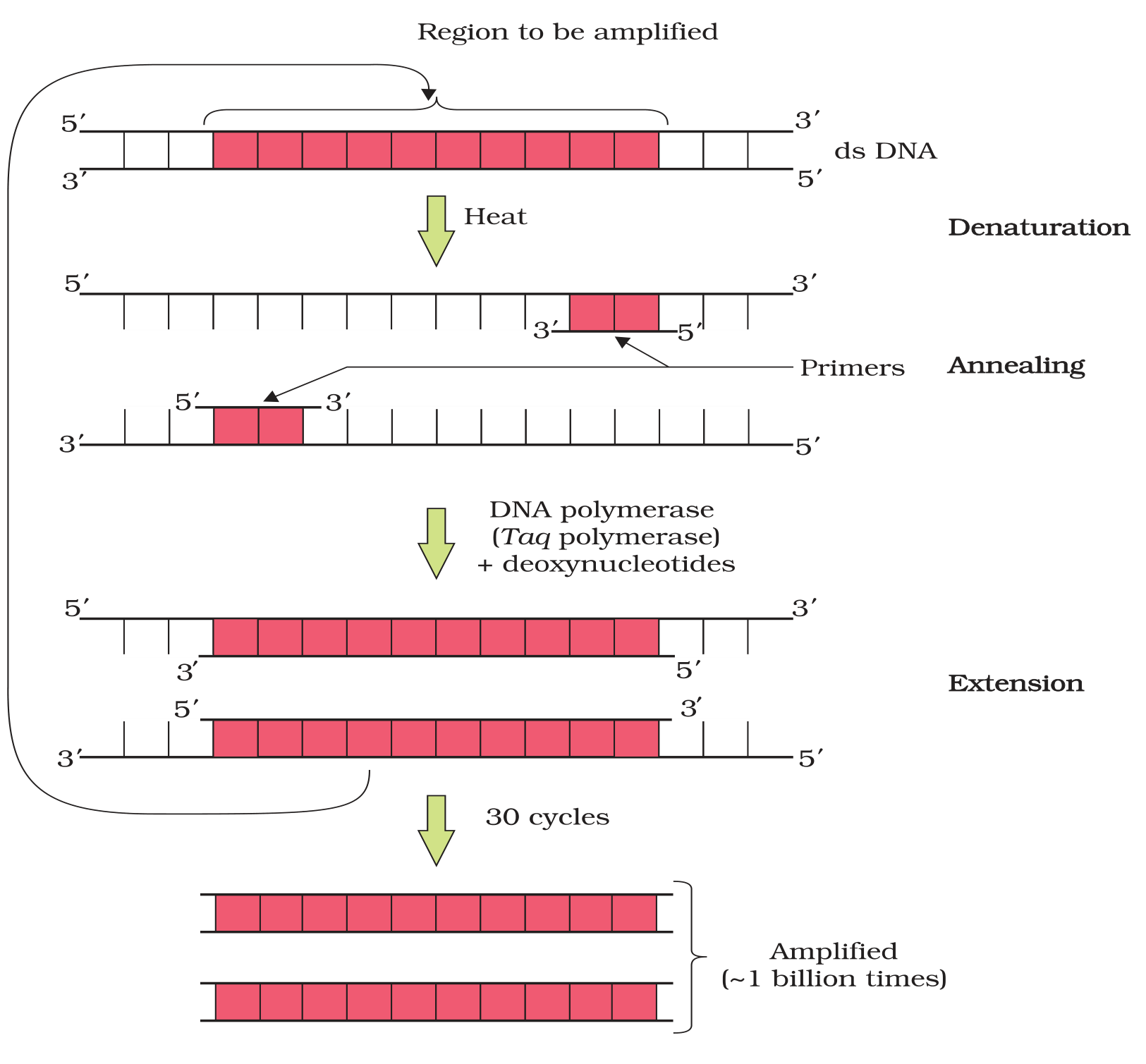
Figure 9.6 Polymerase chain reaction (PCR) : Each cycle has three steps: (i) Denaturation; (ii) Primer annealing; and (iii) Extension of primers