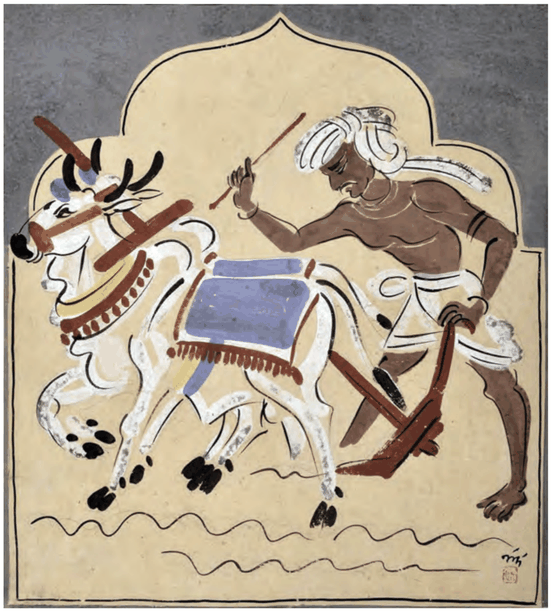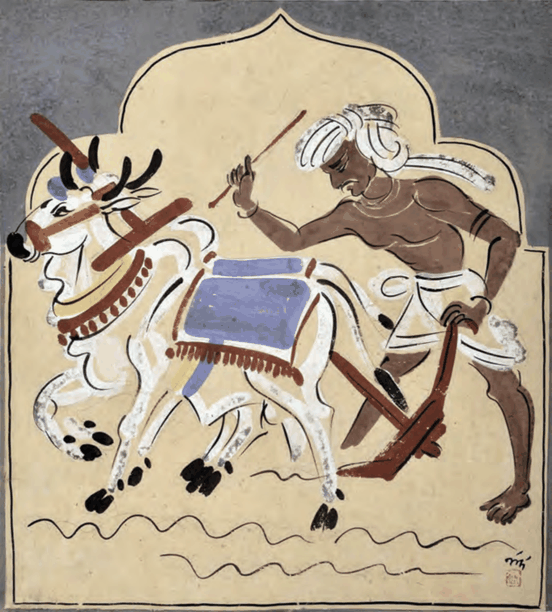
The panel shown above was made by Nandalal Bose for the Haripura Congress. Which technique and style did he use for his Haripura panels?
Answer & explanation
Correct answer: option 3
The correct answer is Option (3) → Thick tempera in a bold cursory style
Option (1) Oil paint along with the wash technique — Incorrect. Oil painting was the western method; Japanese artists taught wash as an alternative to it. The Haripura panels are in tempera.
Option (2) Watercolour in fine lines and delicate tones — Incorrect. Fine lines and delicate tones render the camel in Journey’s End, a watercolour by Abanindranath Tagore.
Option (3) Thick tempera in a bold cursory style — Correct. Bose used thick tempera in a bold cursory style and broad brushwork, after the folk art of patuas or scroll painters.
Option (4) Wash technique with soft, misty tones — Incorrect. Soft, misty tones come from the wash technique, as in Journey’s End. Bose’s panels use a folk style instead.
NCERT (2026-27): “Tiller of the Soil … To capture the essence of village life in his Haripura panels, Bose made pen-and-ink brush studies of local villagers. He used thick tempera in a bold cursory style and broad brushwork. This technique and style was reminiscent of the folk art practice of patuas or scroll painters. Folk style is purposely used to represent the rural life.…”
|