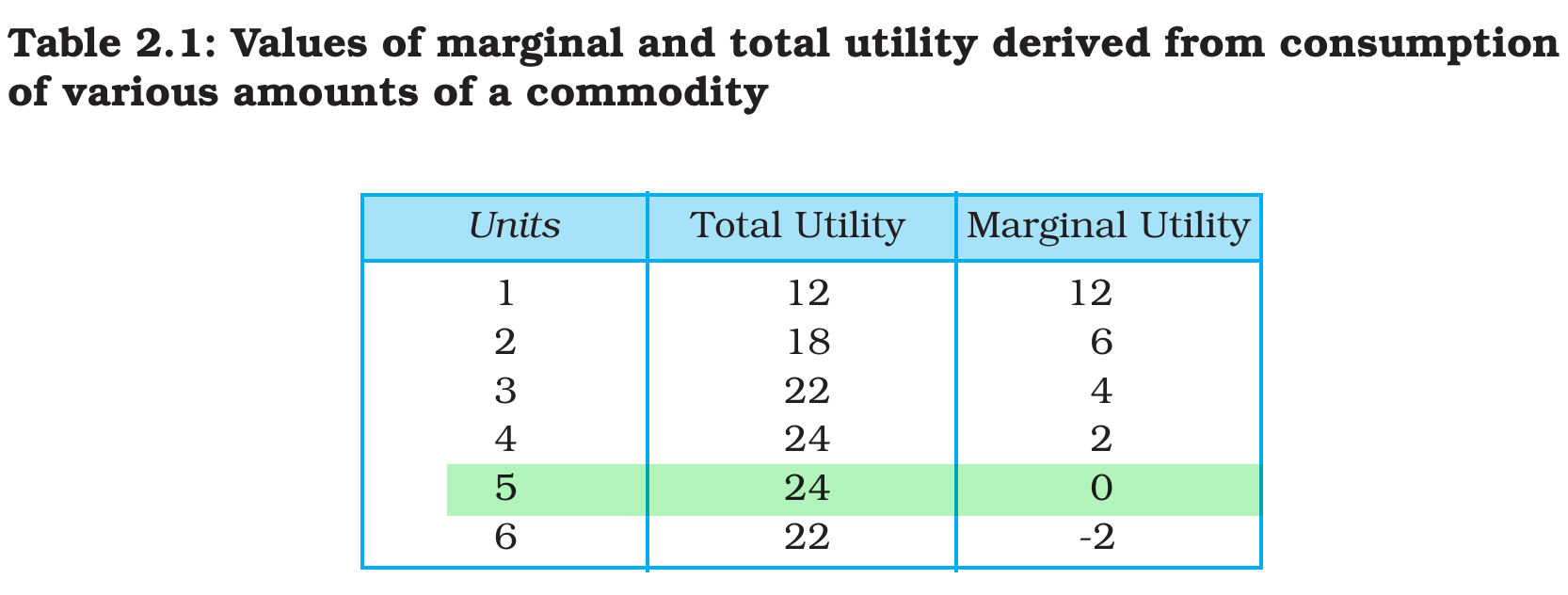
When total utility remains constant the value of marginal utility is _____________.
Answer & explanation
Correct answer: option 2
The correct answer is Option (2) → Zero
Marginal utility (MU) is the change in total utility (TU) from consuming one more unit of a good. If TU stays the same when one more unit is consumed, the change is nil, so MU is zero. For example, if 4 units give a TU of 24 and 5 units also give 24, the MU of the fifth unit is 0.
Option (1) Maximum — Incorrect. At this point it is total utility that is at its maximum. MU has been falling with each unit and has come down to zero.
Option (2) Zero — Correct. An extra unit adds nothing to total utility, so its marginal utility is zero.
Option (3) Negative — Incorrect. MU becomes negative only when one more unit makes total utility fall.
Option (4) Minimum — Incorrect. MU can go on falling below zero, so zero is not its lowest value.
NCERT (2026-27): “Measures of Utility … Law of Diminishing Marginal Utility states that marginal utility from consuming each additional unit of a commodity declines as its consumption increases, while keeping consumption of other commodities constant. MU becomes zero at a level when TU remains constant. In the example, TU does not change at 5th unit of consumption and therefore MU5 = 0. Thereafter, TU starts falling and MU becomes negative.”
|