Read the passage and answer the following questions:-
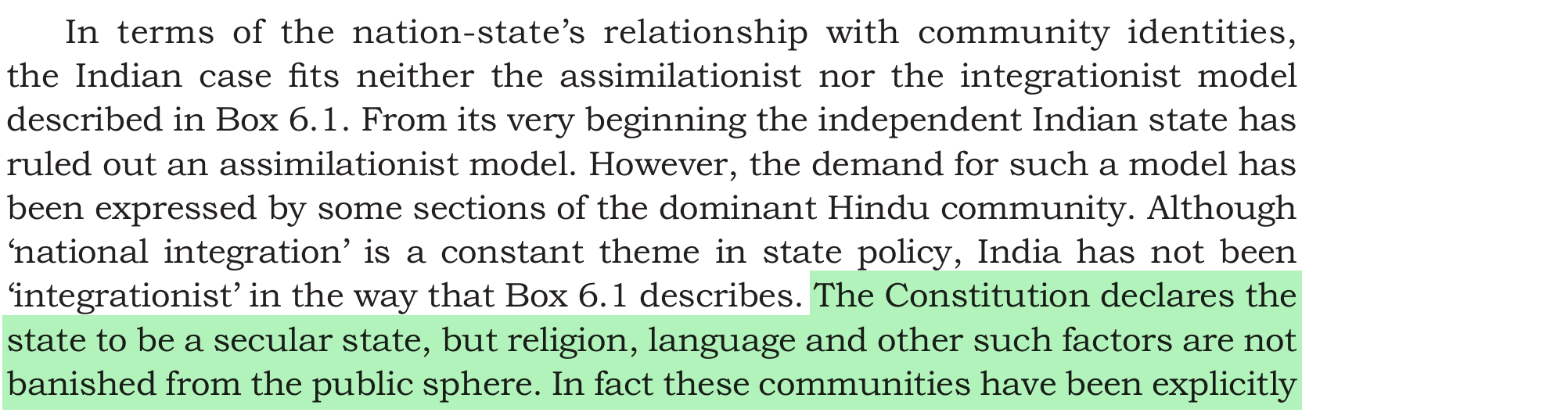
In terms of the nation-state's relationship with community identities, the Indian case fits neither the assimilationist nor the integrationist model described in Box 6.2. From its very beginning the independent Indian state has ruled out an assimilationist model. However, the demand for such a model has been expressed by some sections of the dominant Hindu community. Although 'nationalist' integration is a constant theme in state policy, India has not been integrationist in the way that Box 6.2 describes. The constitution declares the state to be a secular state, but religion, language and other such factors are not banished from the public sphere. In fact these communities have been explicitly recognised by the state. By international standards, very strong constitutional protection is offered to minority religions. In general India's problems have been more in the sphere of implementation and practice rather than laws or principles. But on the whole, India can be considered a good example of a state nation though it is not entirely free from the problems common to nation states.
Identify the specificity of India as a secular state.
Answer & explanation
Correct answer: option 2
The correct answer is Option (2) → constitutional protection to religion
Option (1) Religion is banished from the public sphere — Incorrect. This is the very thing India does not do. The Constitution declares the state to be a secular state, but religion, language and other such factors are not banished from the public sphere.
Option (2) constitutional protection to religion — Correct. What is specific to Indian secularism is that religious communities are explicitly recognised by the state, and by international standards very strong constitutional protection is offered to minority religions.
Option (3) disregard towards religious differences to strengthen unity — Incorrect. Keeping differences out of sight for the sake of unity is the way of integrationist states, which push cultural differences out of the public and political arena. India has not been integrationist in this way: its religious communities are explicitly recognised by the state, not disregarded.
Option (4) adopting the policy of one nation one religion — Incorrect. One religion for the whole nation would be an assimilationist policy. Some sections of the dominant Hindu community have demanded such a model, but the Indian state ruled it out from its very beginning.
NCERT: Indian Society — Chapter 6: The Challenges of Cultural Diversity (2025-26)
|