Choose a statement that is incorrect for the three tier Panchayati Raj Institutions:
Answer & explanation
Correct answer: option 4
The correct answer is Option (4) → The 77th amendment provided constitutional status to the Panchayati Raj Institutions
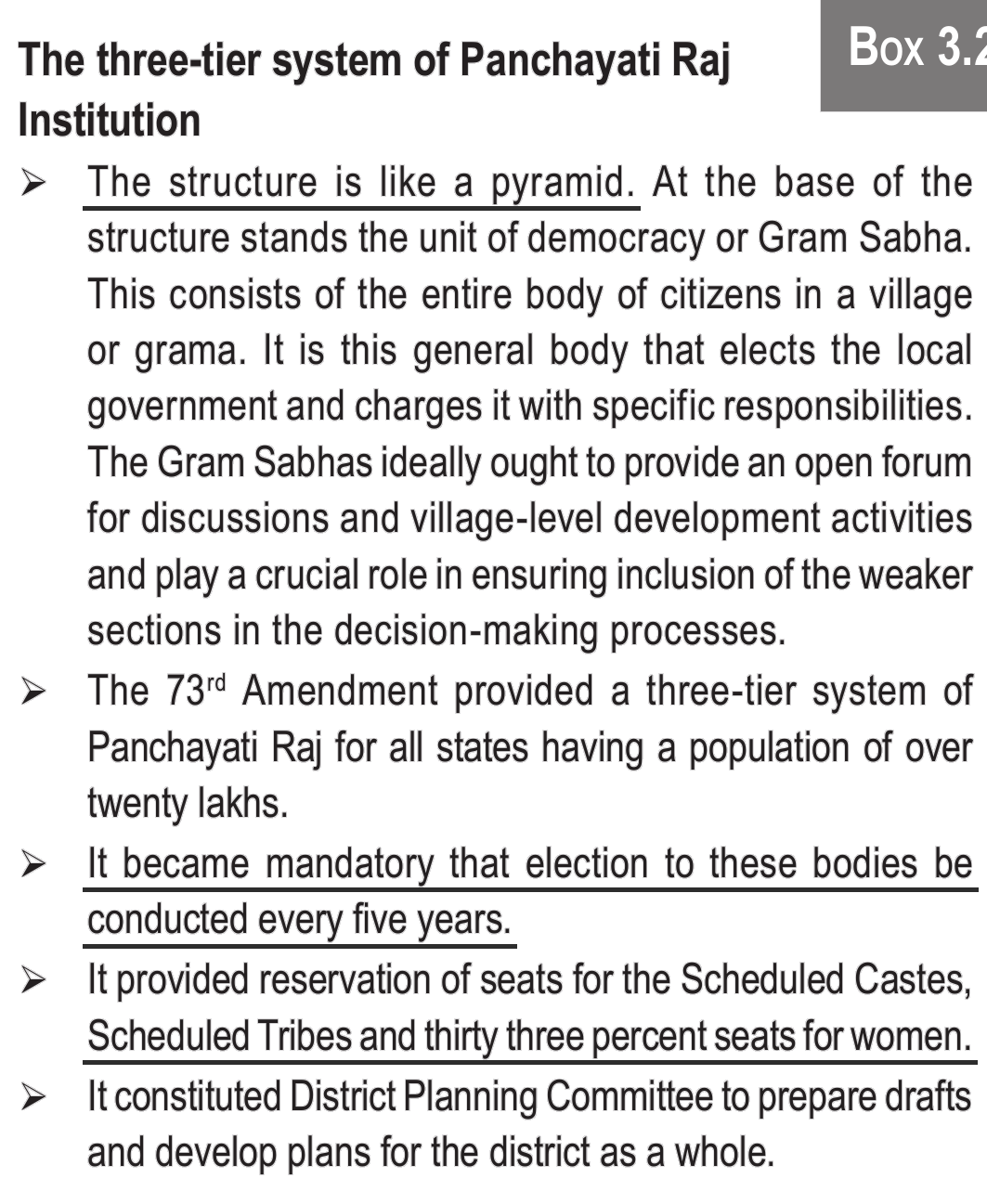
Option (1) Its structure is like a pyramid — A correct statement (Incorrect). The three-tier structure is like a pyramid: at its base stands the Gram Sabha, the entire body of citizens of a village, which elects the local government.
Option (2) Elections to the Panchayati Raj Bodies are conducted every five years — A correct statement (Incorrect). It became mandatory that elections to these bodies be conducted every five years.
Option (3) It provided 33% reservation to women — A correct statement (Incorrect). Seats were reserved for the Scheduled Castes and Scheduled Tribes, and thirty three percent of the seats for women.
Option (4) The 77th amendment provided constitutional status to the Panchayati Raj Institutions — An incorrect statement (Correct). Constitutional status was given by the 73rd Constitutional Amendment of 1992, which ushered in grassroot democracy, not by a 77th amendment.
Note: The chapter ‘The Story of Indian Democracy’ of the pre-rationalised NCERT, which NTA followed in 2023, has been renamed ‘The Constitution and Social Change’ in the NCERT book (2025-26). Its section on Panchayati Raj and the 73rd Amendment, with the three-tier structure, is still there.
NCERT (2025-26): “3.1 The Panchayati Raj and the Challenges … It was, however, only in 1992 that grassroot democracy or decentralised governance was ushered in by the 73rd Constitutional Amendment. This act provided constitutional status to the Panchayati Raj Institutions (PRIs). It is compulsory now for local self-government bodies in rural and municipal areas to be elected every five years. More importantly, control of local resources is given to the elected local bodies.”
Box 3.2 (NCERT 2025-26) |