Identify the correct options from the statements given below.
(A) Al-Biruni wrote 'Kitab-ul-Hind' in Persian.
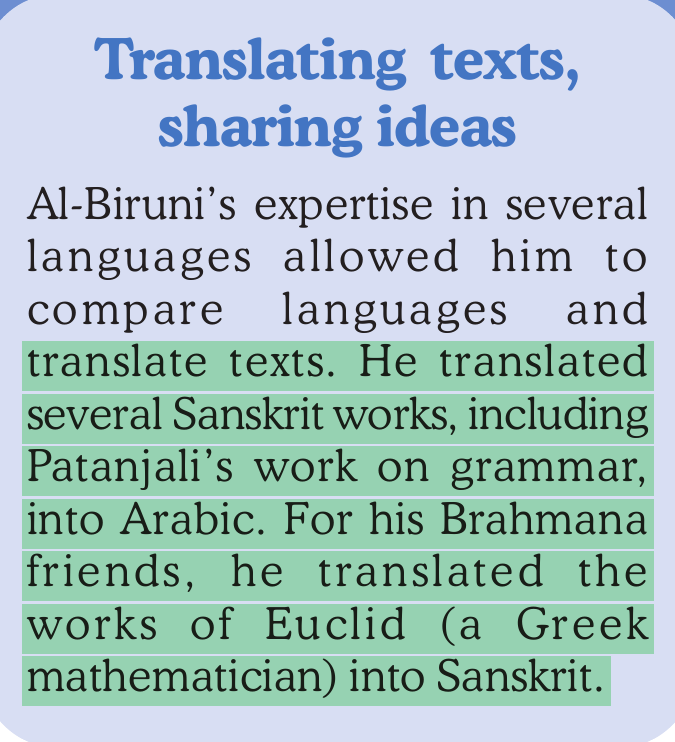
(B) He translated several Sanskrit works such as Patanjali's work on grammar into Arabic.
(C) Al-Biruni was born in Khwarizm, present-day Uzbekistan.
(D) Al-Biruni was born in Ghazni, Afghanistan.
(E) He translated the works of Euclid (a Greek mathematician) into Sanskrit.
Choose the correct answer from the options given below:
Answer & explanation
Correct answer: option 1
The correct answer is Option (1) → (B), (C), (E) Only
(A) Al-Biruni wrote ‘Kitab-ul-Hind’ in Persian. Incorrect. Al-Biruni’s Kitab-ul-Hind was written in Arabic; it is a voluminous text of 80 chapters.
(B) He translated several Sanskrit works such as Patanjali’s work on grammar into Arabic. Correct. His command of several languages let him translate texts: he translated several Sanskrit works, including Patanjali’s work on grammar, into Arabic.
(C) Al-Biruni was born in Khwarizm, present-day Uzbekistan. Correct. Al-Biruni was born in 973, in Khwarizm in present-day Uzbekistan, an important centre of learning.
(D) Al-Biruni was born in Ghazni, Afghanistan. Incorrect. Ghazni was Sultan Mahmud’s capital, to which Al-Biruni was taken as a hostage in 1017 after Mahmud invaded Khwarizm; he spent the rest of his life there, but he was born in Khwarizm.
(E) He translated the works of Euclid (a Greek mathematician) into Sanskrit. Correct. For his Brahmana friends, he translated the works of Euclid into Sanskrit.
NCERT (2026-27): “1.1 From Khwarizm to the Punjab … Al-Biruni was born in 973, in Khwarizm in presentday Uzbekistan. Khwarizm was an important centre of learning, and Al-Biruni received the best education available at the time. He was well versed in several languages: Syriac, Arabic, Persian, Hebrew and Sanskrit. Although he did not know Greek, he was familiar with the works of Plato and other Greek philosophers, having read them in Arabic translations. In 1017, when Sultan Mahmud invaded Khwarizm, he took several scholars and poets back to his capital, Ghazni; Al-Biruni was one of them. He arrived in Ghazni as a hostage, but gradually developed a liking for the city, where he spent the rest of his life until his death at the age of 70.… 1.2 The Kitab-ul-Hind … Al-Biruni’s Kitab-ul-Hind, written in Arabic, is simple and lucid. It is a voluminous text, divided into 80 chapters on subjects such as religion and philosophy, festivals, astronomy, alchemy, manners and customs, social life, weights and measures, iconography, laws and metrology.…”
|