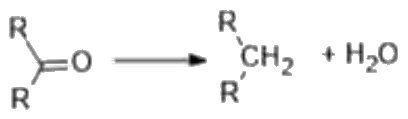
Which of the following reagents are used for the conversion given below:
A. NaBH4/ LiAlH4
B. Zn-Hg/HCl
C. H2NNH2 - KOH/Ethylene glycol
D. H2/Pd
Choose the correct answer from the options given below:
Answer & explanation
Correct answer: option 3
The correct answer is Option (3) → B and C only
The conversion replaces the carbonyl oxygen by two hydrogens: >C=O becomes >CH2. Only two standard reactions reduce a carbonyl group all the way to \( \ce{CH2} \); most reducing agents stop at the alcohol, >CH–OH.
Clemmensen reduction uses zinc amalgam and concentrated hydrochloric acid:
\( \displaystyle \ce{R2C=O} \xrightarrow{\ce{Zn-Hg}\text{/conc. }\ce{HCl}} \ce{R2CH2 + H2O} \)
Wolff-Kishner reduction first forms the hydrazone with hydrazine, which is then heated with KOH in a high-boiling solvent such as ethylene glycol:
\( \displaystyle \ce{R2C=O} \xrightarrow[-\ce{H2O}]{\ce{NH2NH2}} \ce{R2C=NNH2} \xrightarrow[\text{ethylene glycol, heat}]{\ce{KOH}} \ce{R2CH2 + N2} \)
A. NaBH4/ LiAlH4 — Incorrect. These hydride reagents reduce a ketone to a secondary alcohol, \( \ce{R2CH-OH} \), not to \( \ce{R2CH2} \):
\( \displaystyle \ce{R2C=O} \xrightarrow{\ce{NaBH4}\text{ or }\ce{LiAlH4}} \ce{R2CH-OH} \)
B. Zn-Hg/HCl — Correct. This is the Clemmensen reduction, which gives \( \ce{R2CH2} \).
C. H2NNH2 - KOH/Ethylene glycol — Correct. This is the Wolff-Kishner reduction, which also gives \( \ce{R2CH2} \).
D. H2/Pd — Incorrect. Catalytic hydrogenation adds \( \ce{H2} \) across the C=O bond and gives the alcohol \( \ce{R2CH-OH} \):
\( \displaystyle \ce{R2C=O + H2} \xrightarrow{\ce{Pd}} \ce{R2CH-OH} \)
NCERT (2026-27 edition):
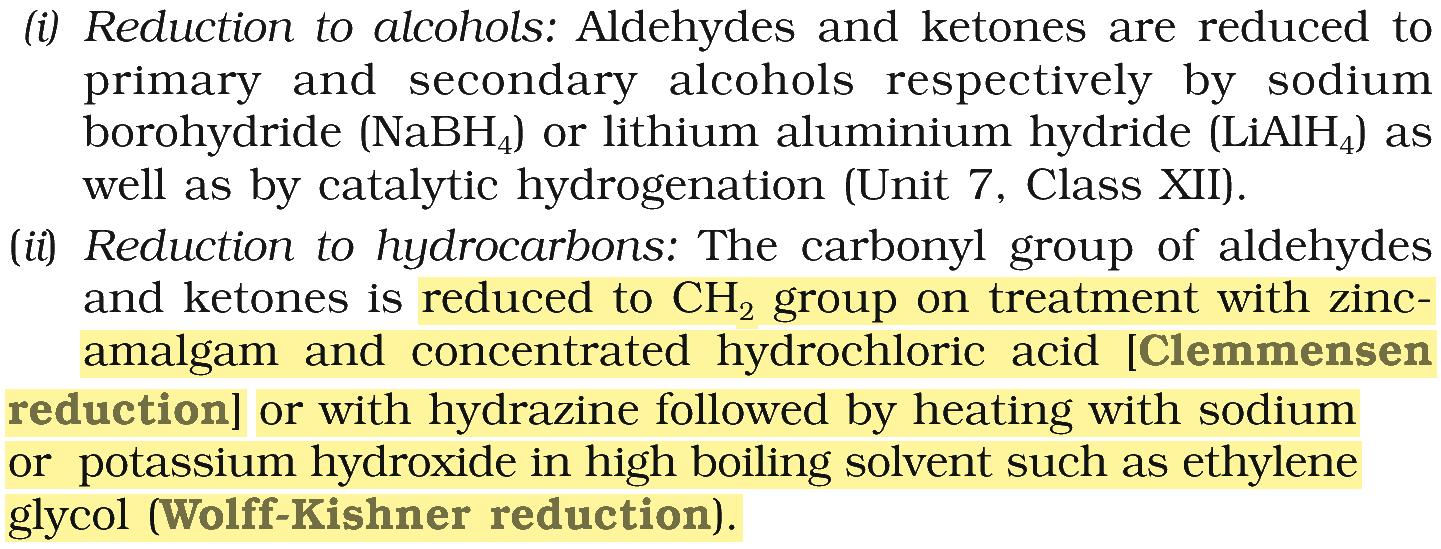
Reduction