
Six friends, A, E, H, M, R and S are seated about a round table. Every chair is equidistant from adjacent chairs. R is seated opposite to E. A is seated second to left of H. S is seated immediate left of E.
Which of the following statements is correct as per the information given above?
A. E is the immediate neighbour of H.
B. H is seated opposite to M.
C. H is not seated next to S.
D. A is seated next to R.
Choose the correct answer from the options given below:
Answer & explanation
Correct answer: option 4
The correct answer is Option (4) → B and D only
All six sit round the table facing the centre, so each person’s left is the clockwise direction. The clues are placed one at a time:
Seat E anywhere; R sits opposite E.
S sits immediately to the left of E, the next seat clockwise from E.
Three seats are left for A, H and M: the seat after S, and the two seats after R. A must be second to the left of H, that is, two seats clockwise from H:
H in the seat after S puts A two seats on, in the seat after R, which is free.
H in either of the two seats after R would put A on E or on S, which are taken.
So H sits next to S, A next to R, and M takes the last seat, between A and E.
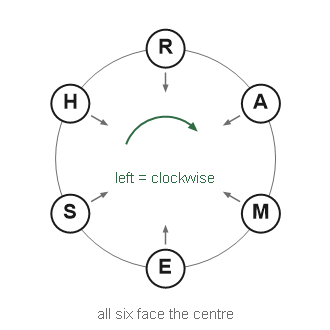
A. E is the immediate neighbour of H. Incorrect. E’s neighbours are S and M; H sits two seats away from E, beyond S.
B. H is seated opposite to M. Correct. Going round from H: S, E, M, so M is three seats from H, the seat facing H.
C. H is not seated next to S. Incorrect. H sits in the seat right after S, so H is next to S.
D. A is seated next to R. Correct. A is second to the left of H, and the seat between them is R’s, so A and R are neighbours.
Note: NTA dropped this question. The original NTA paper printed statement A as “E is the immediate neighbour of M.” That statement is also true (M sits next to E), so the true statements were A, B and D, and no option gave that combination. For the benefit of students and to keep a single answer, statement A has been changed to “E is the immediate neighbour of H.”, which is false; B and D are then the only true statements.