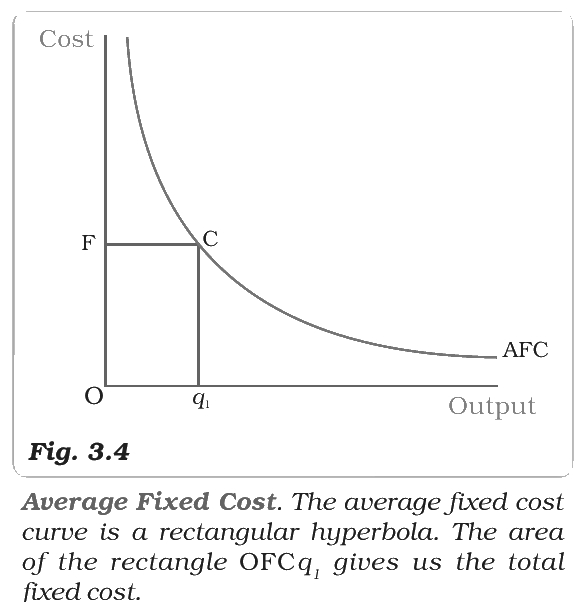
Assertion (A): AFC curve is, in fact, a rectangular hyperbola.
Reason (R): AFC is total fixed cost divided by output, and total fixed cost does not change with output, so output multiplied by AFC is always the same constant.
Answer & explanation
Correct answer: option 1
The correct answer is Option (1) → Both Assertion (A) and Reason (R) are true and Reason (R) is the correct explanation of Assertion (A).
Assertion (A): AFC curve is, in fact, a rectangular hyperbola. — True. AFC falls all the time: very large near zero output and close to zero at very large output.
Reason (R): AFC is total fixed cost divided by output, and total fixed cost does not change with output, so output multiplied by AFC is always the same constant. — True. AFC = TFC/q, and TFC is a constant.
Why R explains A?
A curve on which output × AFC always gives the same number is a rectangular hyperbola. R shows that this product is always TFC, a constant. So R is the reason the AFC curve has this shape.
NCERT (2026-27): “Shapes of the Short Run Cost Curves … AFC is the ratio of TFC to q. TFC is a constant. Therefore, as q increases, AFC decreases. When output is very close to zero, AFC is arbitrarily large, and as output moves towards infinity, AFC moves towards zero. AFC curve is, in fact, a rectangular hyperbola. If we multiply any value q of output with its corresponding AFC, we always get a constant, namely TFC.”
|