
The figure shows the concentration of butyl chloride, C4H9Cl, plotted against time during its hydrolysis, \( \ce{C4H9Cl + H2O -> C4H9OH + HCl} \).
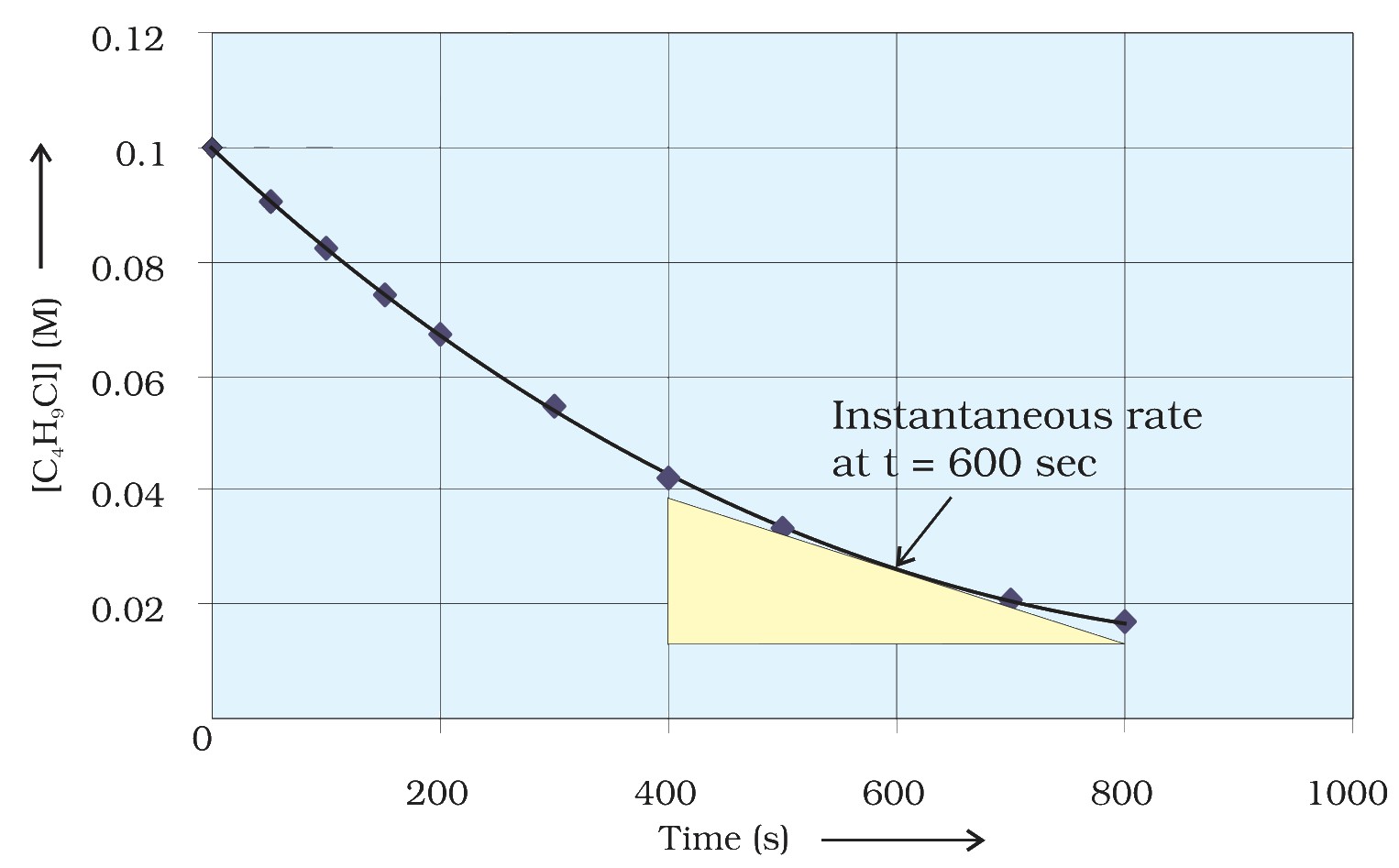
Using the plotted points, the average rate of the reaction over the first 200 s is closest to:
Answer & explanation
Correct answer: option 4
The correct answer is Option (4) → 1.65 × 10⁻⁴ mol L−1 s−1
The average rate is the decrease in the concentration of the reactant divided by the time interval.
From the graph: [C4H9Cl] = 0.100 M at t = 0 s and about 0.067 M at t = 200 s.
\( \displaystyle r_{av} = -\frac{\Delta[\ce{C4H9Cl}]}{\Delta t} \)
\( \displaystyle r_{av} = -\frac{(0.067 - 0.100)\ \mathrm{mol\,L^{-1}}}{(200 - 0)\ \mathrm{s}} \)
\( \displaystyle r_{av} = \frac{0.033\ \mathrm{mol\,L^{-1}}}{200\ \mathrm{s}} = 1.65 \times 10^{-4}\ \mathrm{mol\,L^{-1}\,s^{-1}} \)
NCERT (2026-27 edition):
3.1 Rate of a Chemical Reaction – “We can determine the difference in concentration over different intervals of time and thus determine the average rate by dividing Δ[R] by Δt”
Fig. 3.2: Instantaneous rate of hydrolysis of butyl chloride (C4H9Cl)