
Which amongst the following undergo iodoform test
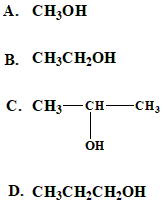
Choose the correct option:
Answer & explanation
Correct answer: option 2
The correct answer is Option (2) → B and C only
The iodoform test (\( \ce{I2} \) + NaOH, i.e. sodium hypoiodite) is given by compounds with a CH3CO– group, or a CH3CH(OH)– group which the hypoiodite oxidises to \( \ce{CH3CO} \)–. The \( \ce{CH3} \) group ends up as yellow \( \ce{CHI3} \).
A. \( \ce{CH3OH} \) — Does not undergo the test. It has no \( \ce{CH3CH(OH)} \)– group.
B. \( \ce{CH3CH2OH} \) — Undergoes the test. It is oxidised to \( \ce{CH3CHO} \), which then gives iodoform:
\( \displaystyle \ce{CH3CH2OH + 4I2 + 6NaOH -> CHI3 v + HCOONa + 5NaI + 5H2O} \)
C. \( \ce{CH3CH(OH)CH3} \) — Undergoes the test. Propan-2-ol is oxidised to acetone:
\( \displaystyle \ce{(CH3)2CHOH + 4I2 + 6NaOH -> CHI3 v + CH3COONa + 5NaI + 5H2O} \)
D. \( \ce{CH3CH2CH2OH} \) — Does not undergo the test. The OH is on the end carbon; it gives propanal, which has no \( \ce{CH3CO} \)– group.
NCERT (2026-27 edition):
Oxidation of Methyl Ketones by Haloform Reaction – …

Note: The same/similar question has been asked in different years by NTA as per the details given below:
| 2026 | 2025 | 2024 | 2023 | 2022 |
|---|---|---|---|---|
| – | – | – | 20-06 S3 09-06 S3 | – |