Read the passage and answer the following question:
Raunak always used to dislike and be afraid of reptiles. Once he was trying to wear his shoes when a lizard jumped out of it. Since then he started getting scared of lizards all the more. He could not control his fear when he saw a snake in his garden. His heart started pounding, he was sweating badly, he even fainted once when someone told him that there is a lizard under his chair. The very thought of any of these reptiles generates in him an extreme level of fear. His mother took him to a doctor, who suggested that Raunak should meet a psychotherapist.
Extreme fear that Raunak is experiencing, falls under the category of _____ disorder-
Answer & explanation
Correct answer: option 1
The correct answer is Option (1) → Anxiety disorder
Option (1) Anxiety disorder — Correct. Raunak’s extreme fear of reptiles is a phobia, and phobias are one of the types of anxiety disorder. High levels of anxiety that are distressing and interfere with effective functioning indicate an anxiety disorder, with symptoms such as a rapid heart rate, sweating and fainting, all seen in Raunak.
Option (2) Somatic symptoms disorder — Incorrect. Here a person has persistent body-related symptoms, worries continually about her or his health and visits doctors often. Raunak’s bodily reactions come only from his fear of reptiles; he is not preoccupied with an illness.
Option (3) Obsessive compulsive disorder — Incorrect. In OCD the person cannot stop a thought or cannot stop repeating an act, such as washing hands every time something is touched. Raunak has no such repeated thought or ritual.
Option (4) Dissociative disorder — Incorrect. Dissociation is a severance of the connections between ideas and emotions, with feelings of unreality, sudden alterations of consciousness, and sometimes a loss or shift of identity. Raunak stays fully aware of who he is and what frightens him.
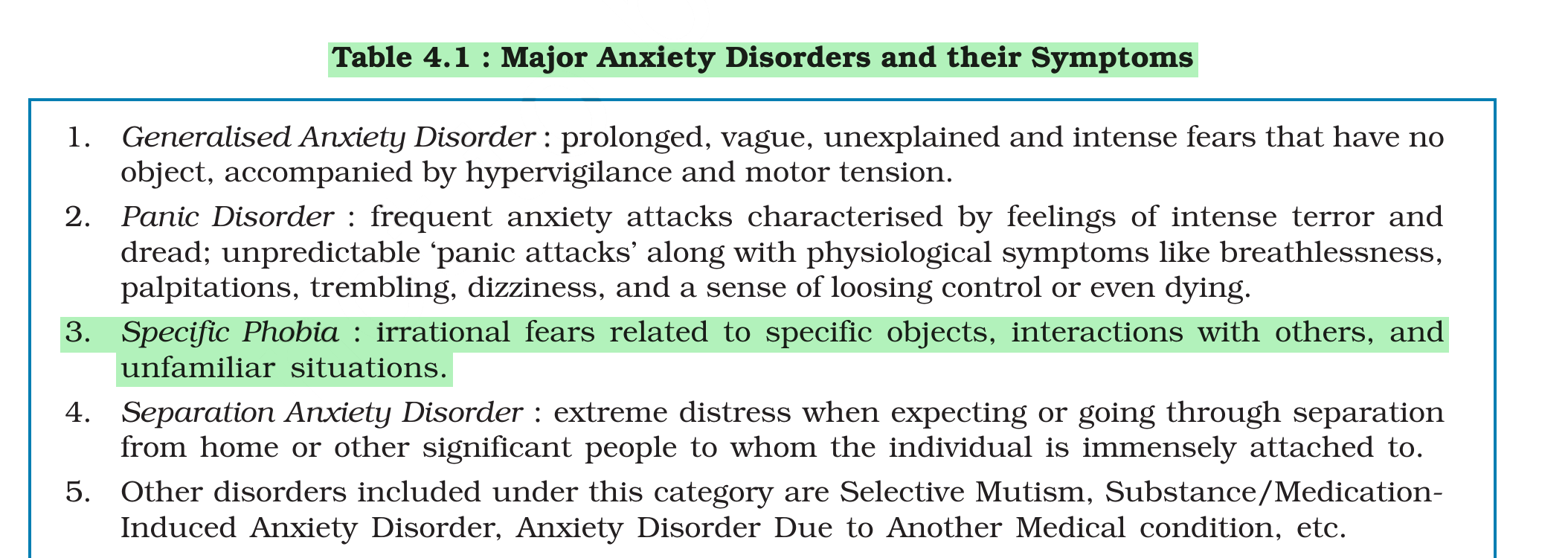
NCERT (2025-26): “Anxiety Disorders … We experience anxiety when we are waiting to take an examination, or to visit a dentist, or even to give a solo performance. This is normal and expected and even motivates us to do our task well. On the other hand, high levels of anxiety that are distressing and interfere with effective functioning indicate the presence of an anxiety disorder — the most common category of psychological disorders. Everyone has worries and fears. The term anxiety is usually defined as a diffuse, vague, very unpleasant feeling of fear and apprehension. The anxious individual also shows combinations of the following symptoms: rapid heart rate, shortness of breath, diarrhoea, loss of appetite, fainting, dizziness, sweating, sleeplessness, frequent urination and tremors. There are many types of anxiety disorders (see Table 4.1).…” “Anxiety Disorders … You might have met or heard of someone who was afraid to travel in a lift or climb to the tenth floor of a building, or refused to enter a room if s/he saw a lizard. You may have also felt it yourself or seen a friend unable to speak a word of a well-memorised and rehearsed speech before an audience. These kinds of fears are termed as phobias. People who have phobias have irrational fears related to specific objects, people, or situations. Phobias often develop gradually or begin with a generalised anxiety disorder. Phobias can be grouped into three main types, i.e. specific phobias, social phobias, and agoraphobia.…”
|