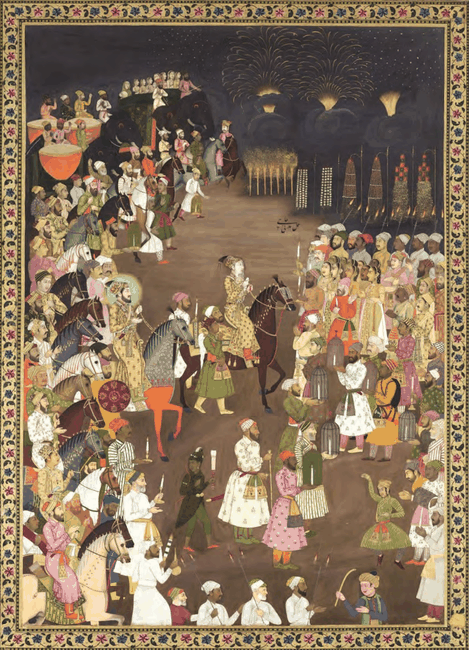
The Marriage Procession of Dara Shikoh is a work by the artist Haji Madni. Consider the following statements about this painting:
(A) It belongs to the period of Shah Jahan, who built the Taj Mahal in Agra.
(B) Dara Shikoh is shown mounted on a white horse.
(C) Shah Jahan is shown with a resplendent nimbus around his head.
(D) The procession is accompanied and received by music, dance, gifts and fireworks.
Choose the correct answer from the options given below:
Answer & explanation
Correct answer: option 2
The correct answer is Option (2) → (A), (C) and (D) only
(A) It belongs to the period of Shah Jahan, who built the Taj Mahal in Agra. — Correct. The painting belongs to the period of Shah Jahan, builder of the Taj Mahal.
(B) Dara Shikoh is shown mounted on a white horse. — Incorrect. Dara rides a brown stallion and wears the traditional sehra. The white horse is Shah Jahan’s.
(C) Shah Jahan is shown with a resplendent nimbus around his head. — Correct. His father, Shah Jahan, has a resplendent nimbus around his head.
(D) The procession is accompanied and received by music, dance, gifts and fireworks. — Correct. Music, dance, gifts and fireworks accompany and receive the procession.
NCERT (2026-27): “The Marriage Procession of Dara Shikoh This painting, a work by artist Haji Madni, belongs to the period of Shah Jahan, who built the Taj Mahal in Agra. It is a portrayal of the marriage procession of Dara Shikoh, the eldest son of Mughal emperor Shah Jahan. The Mughal prince is shown mounted on a brown stallion with the traditional sehra and is accompanied by his father, Shah Jahan, who has a resplendent nimbus around hid head, riding a white horse. The marriage procession is accompanied and received by music, dance, gifts and fireworks.”
|