
CUETMOCK
  • Pricing
  • Mentors
Log inStart freeStart free mocks→

First test, then trust

Try a free CUET mock test.

Join 5,00,000+ students who rehearsed exam day on the exact NTA screen before sitting CUET. On the web and on Android.

Start free mocks →Get the Android app
CUETMOCK

India's #1 CUET Mock Test Platform. Original NCERT-based questions on the exact NTA exam screen — trusted by 5,00,000+ students since CUET 2022.

Get it onGoogle PlayScan to download the CUETMOCK app

Mock tests

  • CUET mock test series
  • Browse all papers
  • Commerce mocks
  • Humanities (Arts) mocks
  • Science mocks
  • Languages & GAT mocks
  • Free practice questions
  • Pricing

Resources

  • CUET exam guide
  • CUET syllabus
  • Universities accepting CUET
  • Expert blogs
  • News & notifications
  • Webinars & counselling
  • CUET score calculator
  • How we estimate your rank
  • FAQs

Company

  • About us
  • Our leadership & team
  • Our toppers
  • Mentors
  • For schools
  • Contact us
  • Terms
  • Privacy
  • Refund policy

Talk to us

+91 7696 6630 56info@cuetmock.comWhatsApp us

Our other platforms

  • JEE Mock — For IIT-JEE aspirants
  • NEET Mock — For NEET aspirants

Newsletter

Exam updates, study material and offers — no spam.

© 2026 NYC Ventures Pvt. Ltd.

701-702, Royal Business Park, Zirakpur, Punjab - 140603

  • Terms of use
  • Privacy policy
  • Refund policy
  • Contact us

iCUETMOCK is an independent preparation platform, not affiliated with the National Testing Agency (NTA). Always check exam details on the official NTA website.

  • Home
  • Mock tests
  • CUET guide
  • Pricing
  • Log in
Home/Practice questions/History
HistoryAncient India: Bricks, Beads and Bones

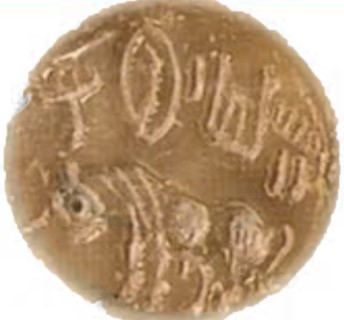
What is the name of the seal shown in the picture?

What is the name of the seal shown in the picture?

Answer & explanation+

Correct answer: option 1

The correct answer is Option 1 - The round “Persian Gulf” seal

The given seal is - The round “Persian Gulf” seal found in Bahrain.

The round “Persian Gulf” seal found in Bahrain sometimes carries Harappan motifs. Interestingly, local “Dilmun” weights followed the Harappan standard.

Advertisement

Practise more on Ancient India: Bricks, Beads and Bones

Chapter-wise mocks on the real NTA exam screen, with solutions and your rank. Your first mocks are free.

Start free mocks →

Advertisement

Next questions

  1. There are two statements marked as Assertion (A) and Reason (R). Mark your answer as per the options given below. Assertion(A): Current acc…Accountancy Part A · Accounting for Partnership
  2. Which of the following statements about sampling error are correct? (A) The sampling error of the mean is x - μ , where x is the sample mea…Applied Maths. Section B2 · Inferential Statistics
  3. Strategic Arms Reduction Treaty (START-1) was signed by USSR President Mikhail Gorbachev and US President George Bush (Senior) in:Political Science · Contemporary World Politics: The Cold War Era
  4. The probability distribution of a random variable X is given below: X0123 P(X)k displaystylek/2 displaystylek/4 displaystylek/8 Then the va…Applied Maths. Section B2 · Probability Distributions
  5. ‘It is not from the benevolence of the butcher, the brewer, of the baker, that we expect our dinner, but from their regard to their own int…Economics · Macro Economics: Introduction
  6. The Satnami Movement in Central India had a motive to:General Aptitude Test · General Knowledge
  7. Which of the following is NOT an approach of Human development?Geography · Fundamentals of Human Geography: Human Development
  8. Match List-I with List-IIList-I (Manuscript)List-II (School of Painting)(A) Nujum al-Ulum(I) Mughal School of Painting(B) Astasahasrika Pra…Fine Arts · The Manuscript Painting Tradition
  9. Krishnadeva Raya belonged to ________ dynasty.History · Medieval India: An Imperial Capital: Vijayanagara
  10. The distribution of the electric field due to charges A and B is shown in figure. The correct statement is:Physics · Electric Charges and Fields