
Which of the following correctly describes the growth of a population when resources in the habitat are unlimited?
Answer & explanation
Correct answer: option 1
The correct answer is Option (1) → Exponential growth, giving a J-shaped curve
When resources (food and space) are unlimited, each species can realise fully its potential to grow in number. The population then grows in an exponential or geometric fashion, and a plot of N against time gives a J-shaped curve. When resources are limited, growth is logistic and the curve is sigmoid (S-shaped), levelling off at the carrying capacity K.
Option (1) Exponential growth, giving a J-shaped curve — Correct. Unlimited resources give exponential growth, and its curve is J-shaped.
Option (2) Logistic growth, giving a sigmoid curve — Incorrect. Logistic growth with a sigmoid curve is what happens when resources are limited, not unlimited.
Option (3) Exponential growth, giving a sigmoid curve — Incorrect. Exponential growth is right for unlimited resources, but its curve is J-shaped. The sigmoid curve belongs to logistic growth.
Option (4) Logistic growth, giving a J-shaped curve — Incorrect. Logistic growth belongs to limited resources, and its curve is sigmoid, not J-shaped.
NCERT Extract:
Growth Models – “… Ideally, when resources in the habitat are unlimited, each species has the ability to realise fully its innate potential to grow in number, as Darwin observed while developing his theory of natural selection. Then the population grows in an exponential or geometric fashion. … The above equation describes the exponential or geometric growth pattern of a population (Figure 11.3) and results in a J-shaped curve when we plot N in relation to time.”
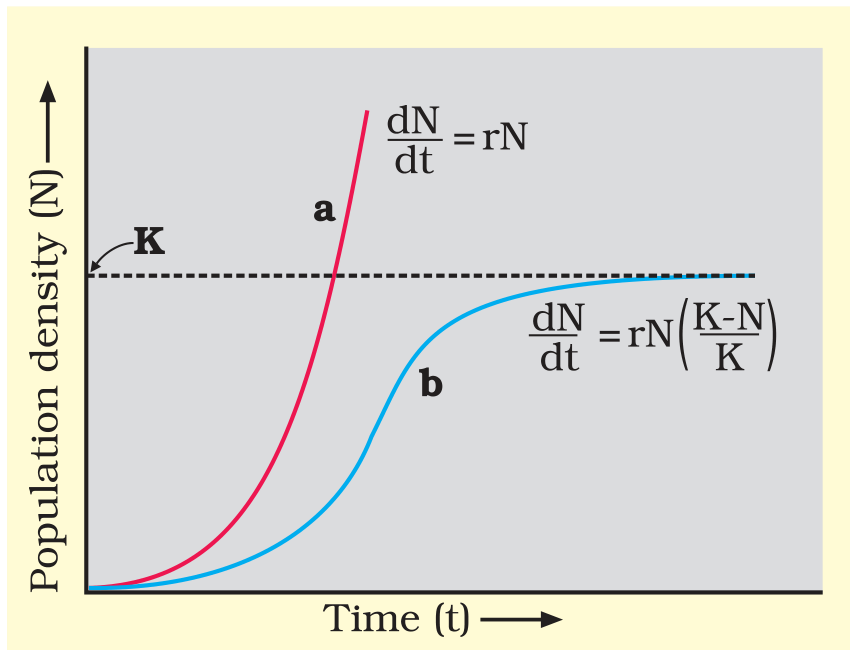
Figure 11.3 Population growth curve: a when responses are not limiting the growth, plot is exponential; b when responses are limiting the growth, plot is logistic; K is carrying capacity