
Match List-I (Mendelian disorders) with List-II (features).
| List-I | List-II |
| (A) Haemophilia | (I) Phenylpyruvic acid and other derivatives are excreted through urine |
| (B) Sickle-cell anaemia | (II) A single protein of the cascade of proteins involved in blood clotting is affected |
| (C) Phenylketonuria | (III) Controlled by two closely linked genes HBA1 and HBA2 on chromosome 16 |
| (D) α Thalassemia | (IV) Mutant haemoglobin undergoes polymerisation under low oxygen tension |
Choose the correct answer from the options given below:
Answer & explanation
Correct answer: option 3
The correct answer is Option (3) → A-II, B-IV, C-I, D-III
(A) Haemophilia — this matches (II) A single protein of the cascade of proteins involved in blood clotting is affected. Haemophilia is a sex-linked recessive disease. With one clotting protein missing, the cascade stops and a simple cut causes non-stop bleeding.
(B) Sickle-cell anaemia — this matches (IV) Mutant haemoglobin undergoes polymerisation under low oxygen tension. Valine replaces glutamic acid at the sixth position of the beta globin chain. The changed haemoglobin polymerises when oxygen is low, and the RBC turns from a biconcave disc into a sickle shape.
(C) Phenylketonuria — this matches (I) Phenylpyruvic acid and other derivatives are excreted through urine. The affected person lacks the enzyme that converts phenylalanine into tyrosine. Phenylalanine builds up and is changed into phenylpyruvic acid and other derivatives, which the kidney absorbs poorly.
(D) α Thalassemia — this matches (III) Controlled by two closely linked genes HBA1 and HBA2 on chromosome 16. In α thalassemia the making of the α globin chain is affected. β thalassemia, by contrast, is controlled by a single gene HBB on chromosome 11.
NCERT Extract:
Mendelian Disorders – “Haemophilia : This sex linked recessive disease, which shows its transmission from unaffected carrier female to some of the male progeny has been widely studied. In this disease, a single protein that is a part of the cascade of proteins involved in the clotting of blood is affected. … The mutant haemoglobin molecule undergoes polymerisation under low oxygen tension causing the change in the shape of the RBC from biconcave disc to elongated sickle like structure (Figure 4.15). Phenylketonuria : This inborn error of metabolism is also inherited as the autosomal recessive trait. The affected individual lacks an enzyme that converts the amino acid phenylalanine into tyrosine. As a result of this phenylalanine is accumulated and converted into phenylpyruvic acid and other derivatives. Accumulation of these in brain results in mental retardation. These are also excreted through urine because of its poor absorption by kidney. … α Thalassemia is controlled by two closely linked genes HBA1 and HBA2 on chromosome 16 of each parent and it is observed due to mutation or deletion of one or more of the four genes.”
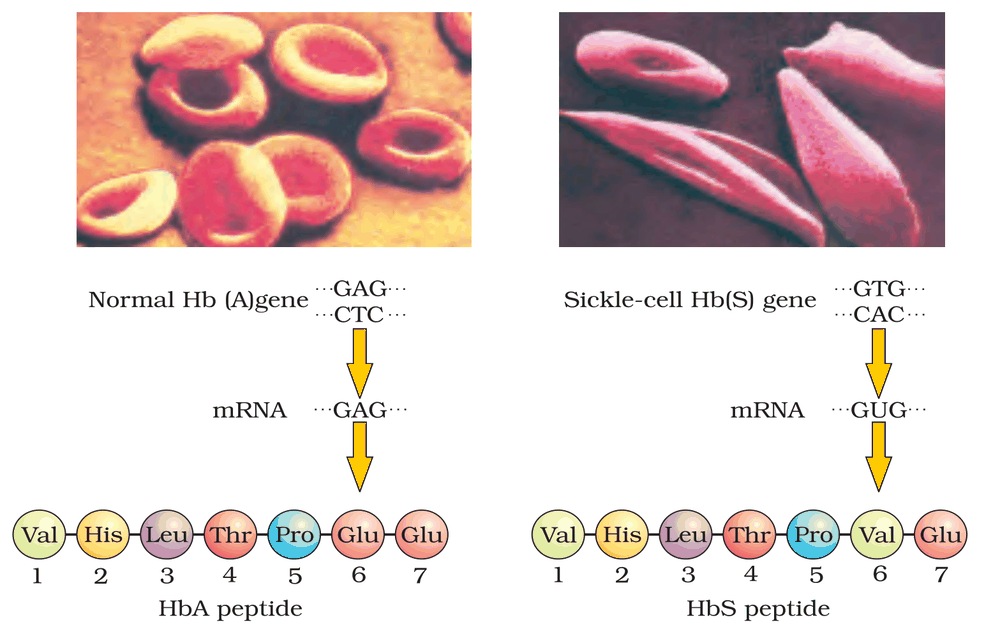
Figure 4.15 Micrograph of the red blood cells and the amino acid composition of the relevant portion of β-chain of haemoglobin: (a) From a normal individual; (b) From an individual with sickle-cell anaemia