CUETMOCK
  • Pricing
  • Mentors
Log inStart freeStart free mocks→

First test, then trust

Try a free CUET mock test.

Join 5,00,000+ students who rehearsed exam day on the exact NTA screen before sitting CUET. On the web and on Android.

Start free mocks →Get the Android app
CUETMOCK

India's #1 CUET Mock Test Platform. Original NCERT-based questions on the exact NTA exam screen — trusted by 5,00,000+ students since CUET 2022.

Get it onGoogle PlayScan to download the CUETMOCK app

Mock tests

  • CUET mock test series
  • Browse all papers
  • Commerce mocks
  • Humanities (Arts) mocks
  • Science mocks
  • Languages & GAT mocks
  • Free practice questions
  • Pricing

Resources

  • CUET exam guide
  • CUET syllabus
  • Universities accepting CUET
  • Expert blogs
  • News & notifications
  • Webinars & counselling
  • CUET score calculator
  • How we estimate your rank
  • FAQs

Company

  • About us
  • Our leadership & team
  • Our toppers
  • Mentors
  • For schools
  • Contact us
  • Terms
  • Privacy
  • Refund policy

Talk to us

+91 7696 6630 56info@cuetmock.comWhatsApp us

Our other platforms

  • JEE Mock — For IIT-JEE aspirants
  • NEET Mock — For NEET aspirants

Newsletter

Exam updates, study material and offers — no spam.

© 2026 NYC Ventures Pvt. Ltd.

701-702, Royal Business Park, Zirakpur, Punjab - 140603

  • Terms of use
  • Privacy policy
  • Refund policy
  • Contact us

iCUETMOCK is an independent preparation platform, not affiliated with the National Testing Agency (NTA). Always check exam details on the official NTA website.

  • Home
  • Mock tests
  • CUET guide
  • Pricing
  • Log in
Home/Practice questions/Business Studies
Business StudiesPrinciples of Management

Amrita used environmental friendly method of production. Which object…

Amrita completed her Master’s Degree in Fashion Technology from Paris. After coming back to India, she observed a shift towards formal wear in the fashion industry. To grab this opportunity, she opened a boutique in a posh area of Delhi.

She used environmental friendly method of production. To make the store run efficiently, she divided the work into small tasks so that her employees are well trained and the wastage can be reduced. Similar activities were grouped together and departments were formed.

She assigned responsibility to her sales staff in the form of clear cut targets and gave them authority to close the deal by offering a discount of 5% but the decision to give any further discount rests with her. The departments were headed by the specialists who were appointed through placement agencies and management consultants. Levels were created in the organization and helped in establishing reporting relationship.

In the earlier period of her venture, she asked her employees to put in extra hours of work. In return, she promised to give them special incentive within one year. Her business was doing well and she honours her commitment by giving them bonus.

Amrita was a good leader. She develops plans and makes decisions in consultation with her subordinates. However, she was biased with her female employees when it comes to solving conflicts among her staff.

Amrita used environmental friendly method of production. Which objective did Amrita try to achieve?

Answer & explanation+

Correct answer: option 2

The correct answer is Option (2) → Social objective

  • Option (1) Personal objective — Incorrect. Personal objectives are about the needs of employees, such as salary and growth. Environment friendly production is not about that.

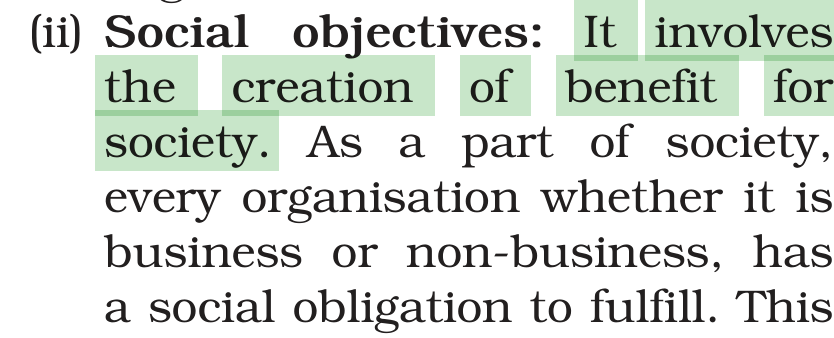
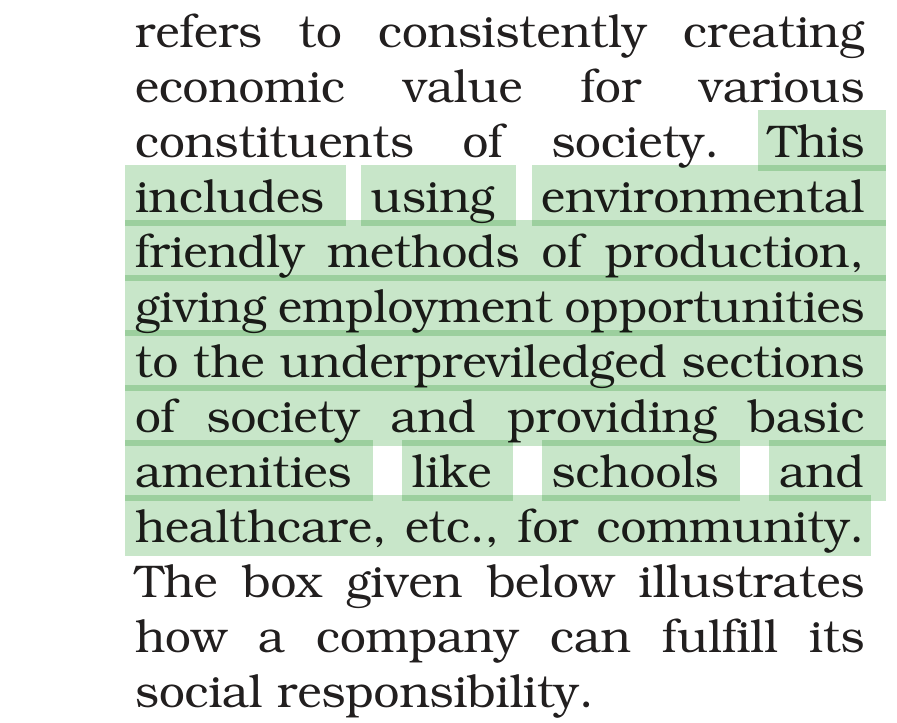
  • Option (2) Social objective — Correct. Social objectives mean creating benefit for society. This includes using environmental friendly methods of production, which is what Amrita did.

  • Option (3) Profit — Incorrect. Profit is an organisational objective, about earning enough to survive and grow. Amrita’s method was chosen for the good of the environment.

  • Option (4) Growth — Incorrect. Growth is an organisational objective about expanding the business. It is not the aim of environment friendly production.

Note: The case study is taken from the chapter ‘Principles of Management’, but this question is based on the chapter ‘Nature and Significance of Management’. However, since it is a case-study based question, all the questions on this case study are tagged to the chapter the case study is taken from.

NCERT (2026-27 Edition):

NCERT extract

NCERT extract

Advertisement

Practise more on Principles of Management

Chapter-wise mocks on the real NTA exam screen, with solutions and your rank. Your first mocks are free.

Start free mocks →

Advertisement

Next questions

  1. The principal value of cos^-1≤ft(-displaystyle1/2) is:Maths. Section B1 · Inverse Trigonometric Functions
  2. The rate constant of a reaction is k = 5.5 × 10⁻⁷ L mol−1 s−1. What is the order of the reaction?Chemistry · Physical: Chemical Kinetics
  3. Choose the option that correctly fills both blanks:If you ______ these tulsi plants twice a week, they ______ the summer heat.English · Grammar: Tenses
  4. Match the words in List-I with their meanings in List-II.List-I (Words)List-II (Meanings)(A) Impecunious(I) Relating to or found on the ban…English · One Word
  5. ∫(x^2+2)/(x^2-3x+2) dx is equal toMaths. Section B1 · Indefinite Integration
  6. Consider the following statements about the green revolution in India:(A) In the first phase, the use of HYV seeds was restricted to more a…Economics · Indian Economic Development: Indian Economy:1950-1990
  7. A situation where two economic agents have complementary demand for each other’s surplus production is called:Economics · Macro Economics: Money and Banking
  8. Consider the circles C_1: x^2+y^2=1 and C_2: x^2+y^2=9 . Which of the following statements are correct? (A) The area of the region between…Maths. Section B1 · Application of Integrals
  9. मास्टर जी की चक्की पर धान कूटनेवाली मशीन क्या माँगती है?Hindi · Comprehension - (Narrative / Factual)
  10. Which of the following words does NOT name a sound made by a bird?English · Odd One Out