In the rate equation
Rate = k [A]x [B]y
x and y indicate how sensitive the rate is to the change in concentration of A and B. Sum of these exponents, i.e., x + y gives the overall order of a reaction whereas x and y represent the order with respect to the reactants A and B respectively.
Hence, the sum of powers of the concentration of the reactants in the rate law expression is called the order of that chemical reaction. Order of a reaction can be 0, 1, 2, 3 and even a fraction. A zero-order reaction means that the rate of reaction is independent of the concentration of reactants.
Another property of a reaction called molecularity helps in understanding its mechanism. The number of reacting species (atoms, ions or molecules) taking part in an elementary reaction, which must collide simultaneously in order to bring about a chemical reaction is called molecularity of a reaction.
The rate constant of a reaction is k = 5.5 × 10⁻⁷ L mol−1 s−1. What is the order of the reaction?
Answer & explanation
Correct answer: option 3
The correct answer is Option (3) → 2
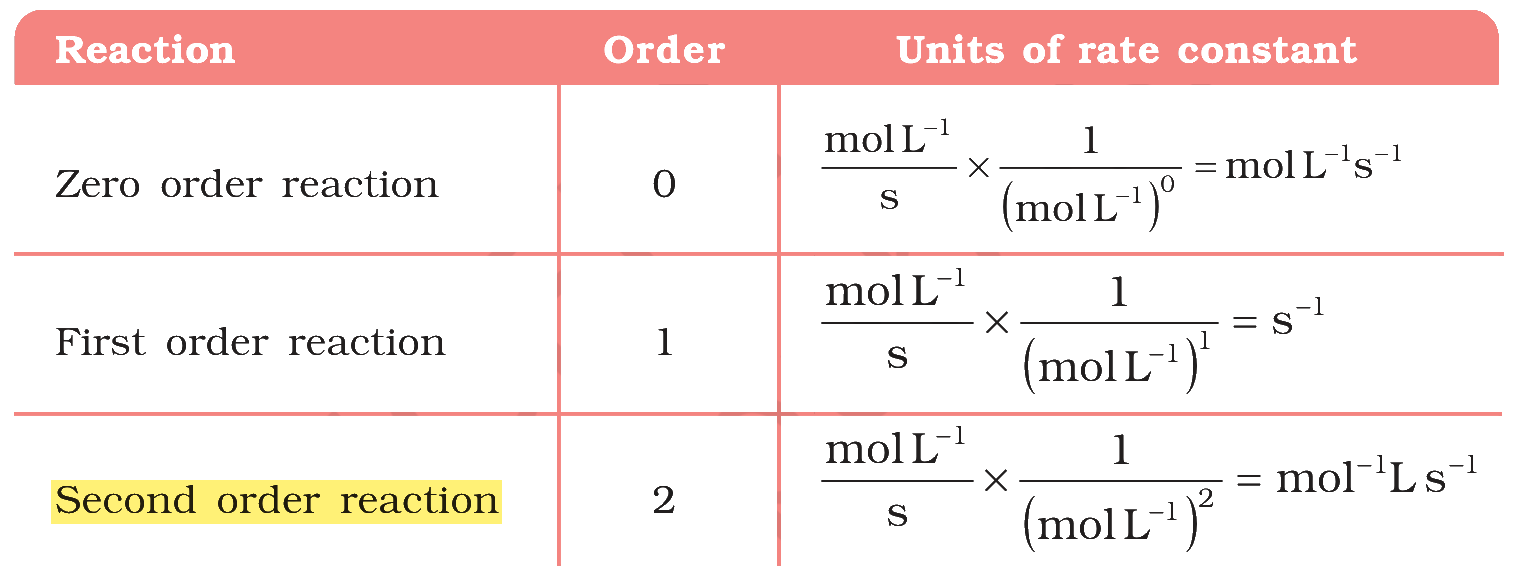
The units of the rate constant depend on the order n. With rate in mol L−1 s−1 and concentration in mol L−1:
\( \displaystyle k=\frac{\text{Rate}}{[\mathrm{A}]^{n}}=\frac{\mathrm{mol\,L^{-1}\,s^{-1}}}{(\mathrm{mol\,L^{-1}})^{n}}=(\mathrm{mol\,L^{-1}})^{1-n}\,\mathrm{s^{-1}} \)
The given k is in L mol−1 s−1 = (mol L−1)−1 s−1, so 1 − n = −1 and n = 2: the reaction is second order.
NCERT (2026-27 edition):
3.2.3 Order of a Reaction – “… Taking SI units of concentration, mol L–1 and time, s, the units of k for different reaction order are listed in Table 3.3”
Table 3.3: Units of rate constant