
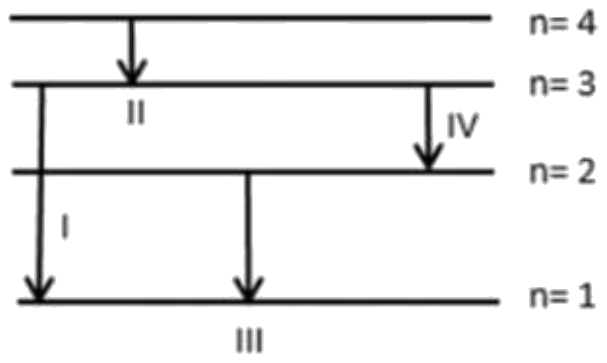
The diagram shows four energy levels of an electron in Bohr's model of hydrogen atom. Identify the transition in which the emitted photon will have shortest wavelength.
Answer & explanation
Correct answer: option 1
The correct answer is Option (1) → I
The emitted photon carries the energy difference between the two levels, \( hc/\lambda = E_i - E_f \), so the largest energy gap gives the shortest wavelength. With \( E_n = -13.6/n^{2} \) eV, the levels are \( E_1 = -13.6 \) eV, \( E_2 = -3.4 \) eV, \( E_3 = -1.51 \) eV and \( E_4 = -0.85 \) eV. Reading the transitions from the figure:
\( \text{I: } n = 3 \rightarrow 1, \quad \Delta E = 12.09\,\mathrm{eV} \)
\( \text{II: } n = 4 \rightarrow 3, \quad \Delta E = 0.66\,\mathrm{eV} \)
\( \text{III: } n = 2 \rightarrow 1, \quad \Delta E = 10.2\,\mathrm{eV} \)
\( \text{IV: } n = 3 \rightarrow 2, \quad \Delta E = 1.89\,\mathrm{eV} \)
Transition I releases the most energy, so its photon has the shortest wavelength.