
Following are the steps to determine the internal resistance of a given primary cell using the potentiometer. Arrange the steps in sequential order.
(A) Keep the readings in the ammeter constant throughout the observation.
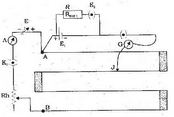
(B) Connect different electrical components. After checking the circuit connections close key \( K_1 \).
(C) Take \( R=10\,\Omega \) (from \( R_{Box\, 1} \)). Close \( K_2 \) and quickly managed the new balance length \( l \). Open \( K_2 \) after this.
(D) Reduce the value of R is equal steps of 1 Ω and obtain \( l \) for each R.
Choose the correct answer from the options given below:
Answer & explanation
Correct answer: option 3
The correct answer is Option (3) → (B), (C), (A), (D)
The internal resistance is found from the balance lengths with the cell on open circuit (\( l_1 \)) and with it shunted by a resistance R (\( l_2 \)), using \( r = R\,(l_1-l_2)/l_2 \). The steps must follow the order of the procedure.
(B) Connect different electrical components. After checking the circuit connections close key \( K_1 \). — comes first: nothing can be measured before the circuit is set up.
(C) Take \( R=10\,\Omega \) (from \( R_{Box\, 1} \)). Close \( K_2 \) and quickly managed the new balance length \( l \). Open \( K_2 \) after this. — is the first observation with the cell shunted by R.
(A) Keep the readings in the ammeter constant throughout the observation. — follows, so that the potential gradient of the wire stays the same.
(D) Reduce the value of R is equal steps of 1 Ω and obtain \( l \) for each R. — comes last.