Read the passage and answer the following questions:-
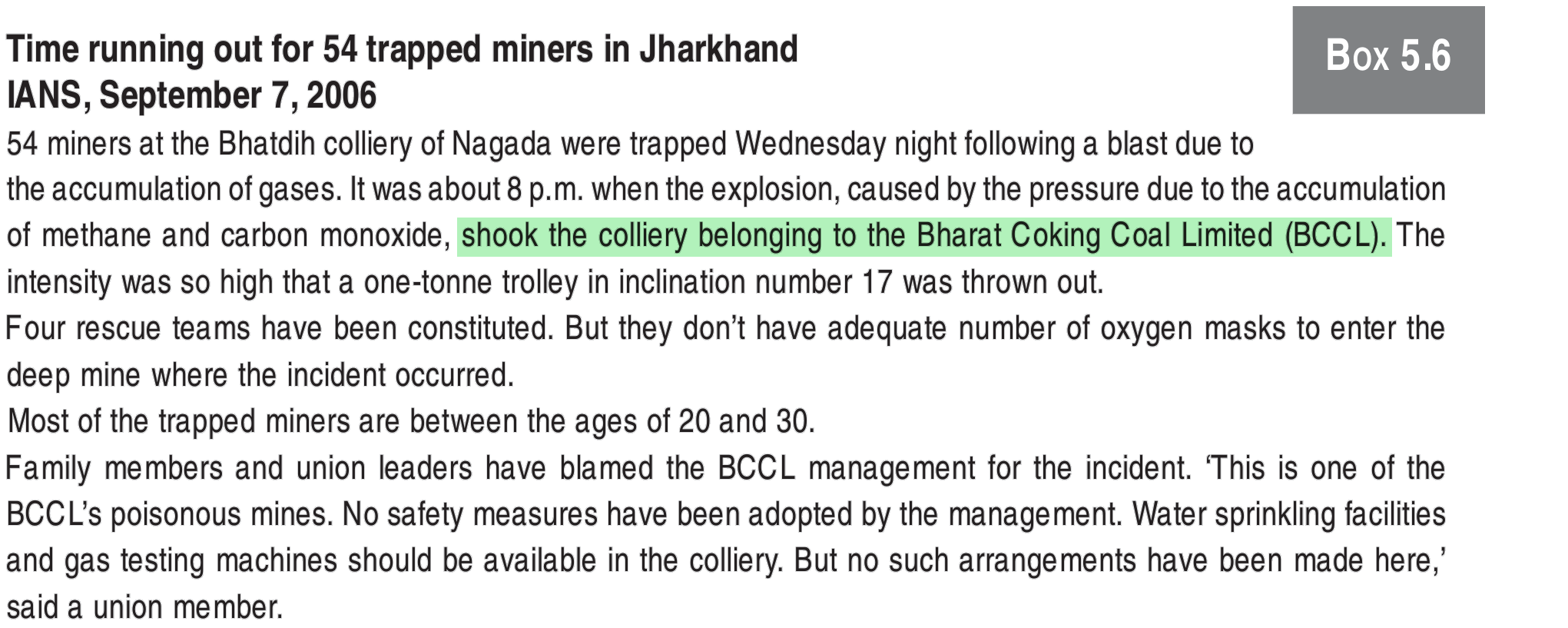
54 miners at the Bhatdih colliery of Nagada were trapped Wednesday night following a blast due to the accumulation of gases. It was about 8 p.m. when the explosion, caused by the pressure due to the accumulation of methane and carbon monoxide, shook the colliery belonging to the Bharat Coking Coal Limited (BCCL). The intensity was so high that a one-tonne trolley in inclination number 17 was thrown out. Four rescue teams have been constituted. But they don't have adequate number of oxygen masks to enter the deep mine where the incident occurred. Most of the trapped miners are between the ages of 20 and 30. Family members and union leaders have blamed the BCCL management for the incident. This is one of the BCCL's poisonous mines. No safety measures have been adopted by the management. Water sprinkling facilities and gas testing machines should be available in the colliery. But no such arrangements have been made here, said a union member.
Mining work as described in the passage is an example of which kind of work?
Answer & explanation
Correct answer: option 1
The correct answer is Option (1) → Public sector organized work
Option (1) Public sector organized work — Correct. The colliery belongs to Bharat Coking Coal Limited (BCCL), a coal company owned by the government (a part of Coal India), so the work is in the public sector. It is also organised work: the organised sector consists of all units employing ten or more people throughout the year, registered with the government so that their employees get proper wages, pension and other benefits. A large colliery with its own management and union, where 54 miners were trapped by a single blast, is such a unit.
Option (2) Private sector organised work — Incorrect. The work is organised, but the owner is not a private company. The family members and union leaders blame the management of BCCL, a government company.
Option (3) Public sector unorganised work — Incorrect. Unorganised work goes on in small workplaces, where personal relationships decide pay and jobs and there are no registered rules. A colliery of a public sector company, with its management and union, is not such a workplace.
Option (4) Private sector unorganised work — Incorrect. Neither part fits. The colliery belongs to a government company, and it is a large unit of the organised sector.
Note 1: The passage, Box 5.6 of the chapter ‘Change and Development in Industrial Society’, was there in the pre-rationalised NCERT, which NTA followed in 2023. The box has been deleted from the NCERT book (2025-26), though the chapter and its section on the organised and unorganised sectors are still there.
Note 2: The passage does not say who owns the colliery. That Bharat Coking Coal Limited is a government company, a subsidiary of Coal India Limited, is not in NCERT (2025-26); explained here for the benefit of the students.
NCERT (2025-26): “The Specificity of Indian Industrialisation … Economists and others often make a distinction between the organised or formal and unorganised or informal sector. There is a debate over how to define these sectors. According to one definition, the organised sector consists of all units employing ten or more people throughout the year. These have to be registered with the government to ensure that their employees get proper salaries or wages, pension and other benefits.…”
Box 5.6, the passage of the question (Pre-rationalised NCERT) |