
CUETMOCK
  • Pricing
  • Mentors
Log inStart freeStart free mocks→

First test, then trust

Try a free CUET mock test.

Join 5,00,000+ students who rehearsed exam day on the exact NTA screen before sitting CUET. On the web and on Android.

Start free mocks →Get the Android app
CUETMOCK

India's #1 CUET Mock Test Platform. Original NCERT-based questions on the exact NTA exam screen — trusted by 5,00,000+ students since CUET 2022.

Get it onGoogle PlayScan to download the CUETMOCK app

Mock tests

  • CUET mock test series
  • Browse all papers
  • Commerce mocks
  • Humanities (Arts) mocks
  • Science mocks
  • Languages & GAT mocks
  • Free practice questions
  • Pricing

Resources

  • CUET exam guide
  • CUET syllabus
  • Universities accepting CUET
  • Expert blogs
  • News & notifications
  • Webinars & counselling
  • CUET score calculator
  • How we estimate your rank
  • FAQs

Company

  • About us
  • Our leadership & team
  • Our toppers
  • Mentors
  • For schools
  • Contact us
  • Terms
  • Privacy
  • Refund policy

Talk to us

+91 7696 6630 56info@cuetmock.comWhatsApp us

Our other platforms

  • JEE Mock — For IIT-JEE aspirants
  • NEET Mock — For NEET aspirants

Newsletter

Exam updates, study material and offers — no spam.

© 2026 NYC Ventures Pvt. Ltd.

701-702, Royal Business Park, Zirakpur, Punjab - 140603

  • Terms of use
  • Privacy policy
  • Refund policy
  • Contact us

iCUETMOCK is an independent preparation platform, not affiliated with the National Testing Agency (NTA). Always check exam details on the official NTA website.

  • Home
  • Mock tests
  • CUET guide
  • Pricing
  • Log in
Home/Practice questions/Chemistry
ChemistryOrganic: Aldehydes, Ketones and Carboxylic Acids

Which type of reactions are favoured by carbonyl compounds?

Which type of reactions are favoured by carbonyl compounds? 

Answer & explanation+

Correct answer: option 2

The correct answer is option 2. Nucleophilic addition reactions.

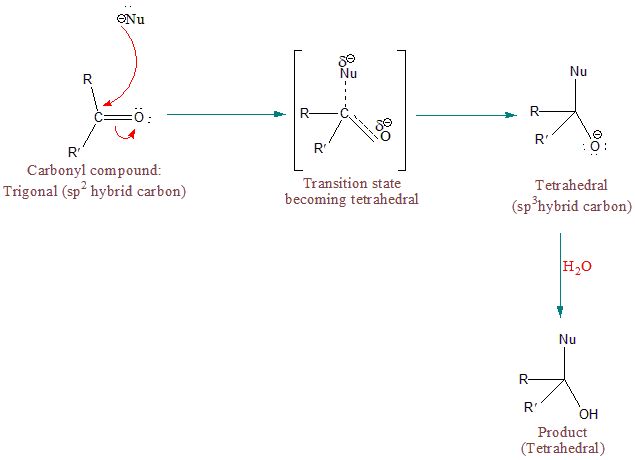
The reaction of the carbonyl group generally involve the formation of bonds with electron deficient carbonyl carbon. The electron rich , i.e., nucleophile will attack at carbonyl carbon in the rate determining step and therefore, these reactions are known as nucleophilic addition reactions. They can be represented as: 
Advertisement

Practise more on Organic: Aldehydes, Ketones and Carboxylic Acids

Chapter-wise mocks on the real NTA exam screen, with solutions and your rank. Your first mocks are free.

Start free mocks →

Advertisement

Next questions

  1. Find ∫ (x^2 + 1)/(x^2 - 5x + 6) dxMaths. Section B1 · Indefinite Integration
  2. ABCD is a cyclic quadrilateral which sides AD and BC are produced to meet at P, and sides DC and AB meet at Q when produced. If ∠ A = 60^°…General Aptitude Test · Quantitative Reasoning
  3. The average height of 12 students of a class is 157.5 cm. If one more student joins the average height becomes 156.6 cm. the height of the…General Aptitude Test · Numerical Ability
  4. Which of the following is not true about cotton textile industry?Geography · India-People and Economy: Manufacturing Industries
  5. The area of the region bounded by parabola x^2 = 4y , straight line x = 2 and x-axis, isMaths. Section A · Application of Integrals
  6. What do you mean by CD?Sociology · Social Change and Development in India: Mass Media and Communication
  7. Select the most appropriate one-word substitution for the given group of words. One whose eating habit is repulsiveEnglish · One Word
  8. In 1990, there was a severe balance of payments problem in India mainly due to:Economics · Macro Economics: Open Economy Macro Economics
  9. What is the name of the artist who created the artwork shown above?1) Rukmini Mukherjee2) Mrinalini Mukherjee3) Anjali Mukherjee4) Arundhat…Fine Arts · The Modern Indian Art
  10. If |vec a|=3,|vec b|=1,|vec c|=4 and vec a+vec b+vec c=0, find the value of vec a.vec b+vec b.vec c+vec c.vec a.Maths. Section B1 · Vectors